

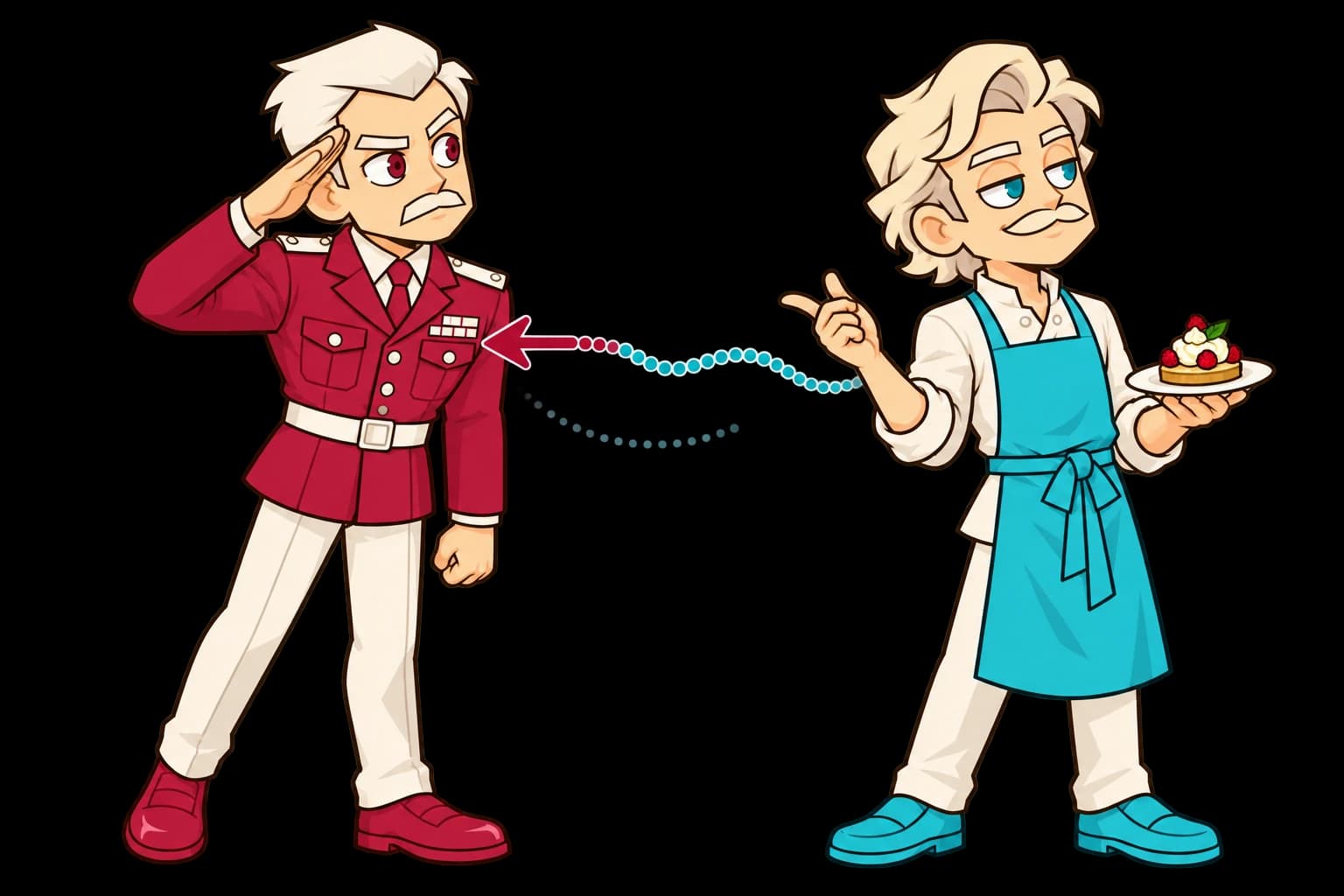
A relationship that moves in one direction: one person listens to the other as they listen to no one else, while the other does not hear them to the same degree.
You can recognize this relationship by its effect before you know its name. One person makes a passing remark—“If I were you, I’d do this”—and it stays with the other for weeks, eventually becoming a decision. The second person offers carefully considered advice on a subject they know well, but it passes by their partner as if it had never been said. Neither person is deliberately ignoring the other. In this relationship, though, words travel much more easily in one direction than in the other.
This relationship is called Benefit. It is asymmetrical: one person is the Benefactor, and the other is the Beneficiary. They never exchange roles. The two types belong to neighboring quadras, share the same energy orientation, and differ in rhythm: one is decisive and the other flexible. This relationship occurs in sixteen type pairs arranged in four cycles. Each type benefits the next type in its cycle and receives benefit from the one before it, so each of us is a Benefactor to one person and a Beneficiary to another.
The curious thing is that both people give, but only one person’s giving gets through. The Beneficiary gives the Benefactor something real—energy, interest, and something engaging to focus on—but it reaches them in a form they do not recognize as a gift. The Benefactor’s contribution, by contrast, reaches the Beneficiary directly at a deep level, making it seem as though only the Benefactor gives. The closest image is wind and sail: the wind pushes the sail forward, and it may look as if the sail does nothing to the wind, even though its shape determines where the journey goes. The explanation will return to this image whenever it helps make the relationship clearer.
The nature of the relation
The relationship rests on one simple idea: what the Benefactor offers reaches the Beneficiary’s deep need directly, while what the Beneficiary offers reaches the Benefactor through a channel they do not readily listen through. This pattern involves the eight aspects of personality explained in “How to Read the Relationship Pages.” Every relationship is a particular way for these aspects to meet. Benefit, like Supervision, is the one relationship in which the two sides do not meet on equal terms: what gets through from one side arrives with extra force, while what comes from the other side arrives weakened.
What distinguishes this relationship is that both of the Benefactor’s ways of expressing themselves reach the Beneficiary’s two receptive channels: the Benefactor’s tool meets the Beneficiary’s hidden need, and the Benefactor’s quiet skill meets what the Beneficiary has to perform in public. The Beneficiary has no equivalent direct route to the Benefactor. Their tool falls on something the Benefactor is good at but dismisses, while their core skill falls on the Benefactor’s steady core. That is why the Benefactor’s words can sound like an instruction that cannot be refused, while the Beneficiary’s words can seem not to have been said at all.
In this relationship, one voice is heard before it rises, while the other can go unheard no matter how loudly it speaks.
Words That Sound Like Instructions
What meets here: the Benefactor’s tool with the Beneficiary’s hidden need, and the Benefactor’s quiet skill with what the Beneficiary has to perform in public.
The result is an influence stronger than either person expects. What the Benefactor says about a subject they know well reaches the Beneficiary and stays with them, even if it was said casually or as a joke. Even the Benefactor’s unselfconscious behavior—their way of dealing with people, their tone, and how they bring situations to a close—becomes a model the Beneficiary imitates in an area that takes effort for them. Many Beneficiaries describe their partner in big terms: “They changed the way I think,” or “I learned more from them than from anyone else.”
The difficulty is that this gives the Benefactor a responsibility they may not realize they have. They speak naturally and do not imagine that one sentence will become a decision. They may make a passing suggestion and find a month later that it has become a plan in motion. This is why the relationship calls for more awareness from the Benefactor: their words carry more weight than they think.
What Energizes the Benefactor—and Wears Them Out
What meets here: the Beneficiary’s core with what excites the Benefactor.
This two-sided effect is the key to the relationship. On one hand, the Benefactor finds a real source of energy in their partner: the Beneficiary cares about what they say, offers something that catches their interest, and may attract them in a way they cannot explain. On the other hand, the Beneficiary’s steady stream can be more than the Benefactor can handle. The Beneficiary talks more than needed, returns to the same topic, and brings all their enthusiasm. The Benefactor becomes tired and may answer with irritation or condescension.
One of the most painful moments in this relationship comes when the Beneficiary offers what is most precious to them—their core—and receives a reply that brushes it aside or makes light of it. The Benefactor does not mean to wound them. The flow was simply more than they could take in, and their response landed on the very point that hurts most.
A Voice That Does Not Get Through
What meets here: the Beneficiary’s tool with something the Benefactor is good at but dismisses, and the Benefactor’s core with the Beneficiary’s quiet skill.
The Benefactor hears the Beneficiary’s practical experience but does not consider it important, replying with a brief remark or changing the subject. The Beneficiary may also have genuine skill in an area that matters to their partner, but they use it in the background rather than displaying it, so the Benefactor may not even notice it. The Beneficiary can develop a lasting feeling that they are not heard. Over time, this becomes either insistence—raising their voice and repeating themselves to get through, which further tires the Benefactor and makes them dismiss the message—or quiet withdrawal, as the Beneficiary loses enthusiasm for the relationship.
The problem is not a moral failing; it is a difference in the channel through which words arrive. The Benefactor is not deliberately ignoring the Beneficiary. What the Beneficiary says reaches the place where the Benefactor is used to filtering information rather than taking it in, so it passes straight through. Knowing this makes a simple adjustment possible: the Beneficiary can explicitly ask to be heard, or present their point briefly in writing so it reaches a channel that works.
What Each Person Expects but Does Not Find
What meets here: the Benefactor’s hidden need with the Beneficiary’s vulnerable point, and what the Benefactor has to perform with what excites the Beneficiary.
The Beneficiary cannot give their partner what the Benefactor needs most deeply, and feels uneasy when asked to do so. The Benefactor therefore remains unsatisfied in this area, however close they become, and looks elsewhere for it. Meanwhile, the Beneficiary is excited by what the Benefactor has to perform in public and admires them in an area where the Benefactor is not strongest. This creates a gentle misreading on both sides: the Beneficiary sees their partner as excellent in something the Benefactor knows they are weak at, making the praise awkward or easy to brush off. The Benefactor expects something their partner cannot provide and may mistake that inability for a lack of care.
This explains a recurring observation: the less the Beneficiary knows the Benefactor, the more they may admire them, while the Benefactor’s closeness with the Beneficiary does not satisfy their own deep need. That is why the relationship often works better at a distance—as teacher and student, or mentor and trainee—than as an equal, day-to-day partnership.
What They Share and Where They Differ
- ValuesThe two types belong to neighboring quadras, so they share half their values. What they exchange in the lively areas between them is something both appreciate. They differ on the other half, and that difference appears in their major priorities: what one considers worth spending a lifetime on may seem like a detail to the other.
- InterestsTheir areas of interest are next to each other. They have enough in common to talk, while the difference makes the Benefactor’s contribution feel new to the Beneficiary. This is one reason the influence works: something new from a nearby field is easier to understand and accept than something from a distant world.
- Rhythm and energy orientationTheir different rhythms can create clashes over schedules and plans. One wants to close a matter, while the other wants to leave it open, increasing the Beneficiary’s sense of being pushed along. Their shared energy orientation shapes how this looks. If both are extraverted, the relationship fills with conversation, and the imbalance becomes clear in who talks more. If both are introverted, the relationship is quieter, and the influence happens in silence: a small piece of advice can have a large effect without its speaker knowing.
How it changes with closeness and time
No relationship stays at one distance or remains the same over time:
By distance
- From a distance
The relationship can feel inspiring. The Beneficiary listens to the Benefactor—in a lecture, a meeting, or a passing conversation—and leaves with something that changes them. The Benefactor finds an enthusiastic listener who cares about what they say. This is often the best distance for the relationship: a strong effect at little cost.
- At a middle distance
The influence grows, and so does the friction. Working together puts the Beneficiary in the position of always being guided and the Benefactor in the position of being asked for more attention than they give. A familiar cycle can begin: the Beneficiary presses to be heard; the Benefactor gets tired and pays less attention; the Beneficiary presses harder.
- Up close
The whole picture appears. The Beneficiary lives with someone they admire but does not feel seen by. The Benefactor lives with someone who gives them energy but does not meet their deep need. Even so, this relationship can work well in many families and workplaces, provided both acknowledge the imbalance instead of denying it. The worst mistake is to demand that the relationship be perfectly equal and judge it by something it does not contain.
Over time
- At the first meeting
The Beneficiary often leaves with a strong impression, while the Benefactor leaves with a pleasant one. The Beneficiary may remember details of what was said years later, while the Benefactor remembers that their partner was “nice and interested.” This difference in the strength of the impact is present from the beginning.
- As they grow closer
The influence speeds up. The Beneficiary takes the Benefactor’s advice, imitates their approach, and makes real progress—one of the most valuable things this relationship offers. At the same time, the Beneficiary begins to feel that they give without being seen, and the Benefactor begins to feel that their partner asks for more than they can give.
- As the relationship settles
It tends to take one of two forms. In an openly acknowledged guidance relationship—teacher and student, or mentor and trainee—both accept their roles, and the relationship works very effectively. In a relationship that claims to be equal, resentment builds in the Beneficiary and exhaustion in the Benefactor. The first form lasts and bears fruit; the second slowly wears both people down.
- Over the long term
The test comes when the Beneficiary matures and wants to be treated as an equal rather than as a student. If the Benefactor can recognize that change, the relationship can become a strong friendship that carries forward its positive history. If the Benefactor stays in the same role, the Beneficiary may quietly withdraw without an argument, taking their partner by surprise. This is probably one of the main reasons these relationships end, though it may not be the only one.
How each sees the other
The same relationship does not look identical from both sides. In Benefit, the difference is especially large because the roles are built into the relationship, not just a matter of mood: one person is heard without effort, while the other works to be heard.
From the Benefactor’s Side
The Benefactor sees someone who is interested and enthusiastic, who listens and appreciates what they say. The Benefactor gives advice easily and does not see it as anything special; they may not realize how much their words affect the other person. At the same time, their partner’s enthusiasm can sometimes wear them out: the conversation goes on, and the interest is greater than they can handle.
The specific risk is getting used to this position and seeing the partner only as a recipient. The Benefactor may stop asking for their opinion, answer their observations with a short remark, and fail to notice that the person in front of them is skilled in the Benefactor’s own field—their skill simply happens in the background. A better approach is to ask directly, “What do you think about this?” and listen all the way through. That one question can correct half of what goes wrong in the relationship.
From the Beneficiary’s Side
The Beneficiary sees someone who has what they lack: a way of dealing with things they would like to learn, and words that open what seemed closed. They value the Benefactor greatly and may admire them more than any person deserves, because what reaches them touches something deep.
The specific risk is that admiration turns into dependence. The Beneficiary may run every decision by their partner, measure themselves against them, and feel let down when they do not receive the same attention in return. A better approach is to understand that limited listening does not mean they are being devalued; it is a one-way channel. They can build their sense of worth in their own field and present their ideas directly and briefly, rather than waiting for someone to notice them.
Where these two accounts meet, we see why the relationship can be valuable despite its imbalance: it is one of the strongest relationships for helping a person grow. The Beneficiary can learn in months what an equal relationship might take years to teach, while the Benefactor gains energy and interest that help them continue in their field. The key is to acknowledge the direction of the relationship. It works when treated as guidance; it becomes tiring when treated as an equal partnership.
The relation across areas of life
Friendship
Friendship in Benefit is unequal by nature: one friend asks for advice and the other gives it; one is more excited by the other’s ideas than by their own. It can be very useful to the Beneficiary and enjoyable to the Benefactor, as long as the Benefactor is not expected to do more than show up and offer an opinion.
The limit is that, with time, the Beneficiary needs to be treated as an equal. If that does not happen, quiet resentment builds until they pull away, surprising the other person. This friendship works best when each person has a different area where their knowledge is recognized, so they can each be the go-to person in their own field.
Romantic Relationships and Marriage
This relationship often begins with clear admiration from the Beneficiary. They find someone who has what they lack, and that person’s influence reaches them deeply. It is a powerful start, but it is unequal from the first day.
Shared life brings two main tests: one person feels unheard, and the other feels asked for more than they can give. Successful marriages of this kind do exist, and there are many of them. They depend on a clear arrangement: areas where the Beneficiary has full decision-making authority and is openly recognized for it; a regular habit where the Benefactor asks their partner’s opinion and listens to the end; and awareness on both sides that the Benefactor’s deep need will not be met here, which is no one’s fault. The greatest danger is acting as if the relationship is perfectly equal and measuring every disagreement by a standard that does not fit.
Work and Cooperation
At work, this relationship is highly effective when its direction matches the hierarchy—for example, when the Benefactor is the manager, trainer, or mentor. Their instructions get through without resistance, the Beneficiary learns quickly, and they see the Benefactor’s approach as a model. This can be one of the most successful forms of professional training.
Things become harder when the roles are reversed and the Beneficiary manages the person who benefits them. The manager may find that their words do not reach the employee as much as expected, while the employee’s opinion affects them more than they would like. The manager then feels that their position is not working. A practical solution is to settle decisions through written procedures rather than personal persuasion, and to define each person’s area of responsibility clearly.
When they disagree
Every relationship has its own pattern of disagreement. In Benefit, conflict tends to pass through three stages:
- The spark
It usually begins with the Beneficiary: an opinion they offered that was ignored, experience they shared that received only a brief reply, or a decision made without asking them. A second spark can come from the other side when the Benefactor feels their partner is demanding more attention than they can give and responds with irritation. A third, less visible but more consequential spark occurs when the Beneficiary takes a passing suggestion from the Benefactor as a firm instruction, acts on it, and later blames the Benefactor for an outcome they never intended.
- Escalation
The disagreement follows a familiar cycle. The Beneficiary presses to be heard; the Benefactor is bothered by the amount coming their way and responds briefly or turns away; the Beneficiary presses harder. Each person’s response makes sense to them: one raises their voice because they have not been heard, while the other gives less attention because they are exhausted. The conflict rarely causes a deep wound, since neither person has what it takes to hit the other’s sensitive point. Still, it can leave the Beneficiary feeling humiliated and the Benefactor feeling drained.
- A way out
The most effective adjustment is a small one from the Benefactor: ask the partner’s opinion and listen to the whole answer without interrupting or summarizing it. This addresses the cause, not just the symptom. What the Beneficiary needs is for their voice to get through, not an extra privilege. The Beneficiary can do their part by presenting their point briefly and once, since pressing harder makes things worse here. When the same disagreements keep returning, it also helps to write down what was agreed: writing carries the Beneficiary’s words through a channel that works.
The relation in each pair
All sixteen pairs share this pattern, but what the two people exchange differs from one pair to another:
ILE gives their partner a logical framework for putting confusing things in order, something EIE does not create easily for themselves, and becomes a model of quick execution. In return, EIE’s dramatic emotional intensity excites ILE at first, then exceeds what they can handle and makes them withdraw. ILE’s warnings about future consequences pass by without effect. What ILE needs—care for comfort and the rhythm of daily life—falls on one of EIE’s weakest points.
EIE gives their partner a sense of timing, helping SEE know when to move forward and when to wait; SEE also sees EIE as a model of openness to possibilities. In return, SEE’s strong presence excites EIE and gives them a push, then wears them out with its intensity. EIE’s judgments about people and their loyalties make little impression. What EIE needs—a stable logical framework—falls on one of SEE’s weakest points.
SEE gives their partner confidence about relationships: who deserves trust and who does not, an area where LSE does not judge as easily. LSE sees SEE as a model of social presence. In return, LSE’s constant productivity excites SEE at first, then becomes pressure when every conversation turns to work. LSE’s concern for quality can seem like pointless nitpicking. What SEE needs—a view of long-term consequences—falls on one of LSE’s weakest points.
LSE gives their partner something they lack: attention to comfort and the pace of the day. ILE finds everyday working life more manageable and sees LSE as a model of decisiveness. In return, ILE’s ideas excite LSE and open new doors, then wear them out when they keep coming without limit. ILE’s logical framework can seem like theory without practical value. What LSE needs—quiet personal loyalty—falls on one of ILE’s weakest points.
SEI gives their partner warmth and a pleasant atmosphere that softens LSI’s strictness, something LSI does not know how to create. LSI sees SEI as a model of personal warmth. In return, LSI’s order and clear rules excite SEI at first, then weigh on them when they turn into constant demands for discipline. LSI’s decisiveness can seem unnecessarily rigid. What SEI needs—a new horizon and open possibilities—falls on one of LSI’s weakest points.
LSI gives their partner decisiveness and the ability to finish things instead of putting them off, something ILI does not readily initiate. ILI sees LSI as a model of attention to practical details. In return, ILI’s insight into future outcomes excites LSI and gives them direction, then wears them out when it becomes prolonged analysis. ILI’s calculations about what is worthwhile can seem like a way to evade the rules. What LSI needs—warmth in the atmosphere—falls on one of ILI’s weakest points.
ILI gives their partner practical solutions and criticism that can help her avoid losses, areas where EII is less capable. EII sees ILI as a model of calm analysis. In return, EII’s honesty and deep appreciation of people excite ILI, then wear them out when they turn into long conversations about relationships. The possibilities EII opens can seem like baseless optimism. What ILI needs—a push and decisiveness in difficult moments—falls on one of EII’s weakest points.
EII gives their partner a view of possibilities that SEI does not open for themselves. SEI sees EII as a model for reading the future and speaking about it with confidence. In return, SEI’s care for comfort and harmony excites EII, then becomes heavy when everything is postponed to keep the peace. SEI’s effort to create a mood can seem superficial. What EII needs—practical competence to organize their work—falls on one of SEI’s weakest points.
ESE gives their partner attention to comfort and concrete details, which IEE tends to overlook. IEE sees ESE as a model of decisiveness and strong presence. In return, IEE’s ideas excite ESE, then tire them when projects keep appearing without settling. IEE’s precise judgments about people can seem to complicate relationships. What ESE needs—a clear logical framework—falls on one of IEE’s weakest points.
IEE gives their partner clarity about who deserves trust, something LIE does not judge as easily. LIE sees IEE as a model of social warmth. In return, LIE’s ambition and competence excite IEE, then wear them out when everything is constantly measured by results. LIE’s view of future consequences can seem pessimistic and limiting. What IEE needs—care for comfort and stability—falls on one of LIE’s weakest points.
LIE gives their partner insight into consequences that can save SLE from acting too quickly, something SLE does not have readily available. SLE sees LIE as a model of openness to opportunities. In return, SLE’s decisiveness and strength excite LIE, then weigh on them when everything becomes a confrontation. SLE’s rules and system can seem rigid and obstructive. What LIE needs—quiet personal loyalty—falls on one of SLE’s weakest points.
SLE gives their partner clear rules that ESE can rely on, and ESE sees SLE as a model of getting things done without fuss. In return, ESE’s emotional warmth excites SLE, then wears them out when it becomes constant noise. SLE may see ESE’s attention to comfort and details as an indulgence. What SLE needs—a view of future consequences—falls on one of ESE’s weakest points.
LII gives their partner a range of possibilities that SLI does not open for themselves. SLI sees LII as a model for talking about the future. In return, SLI’s attention to comfort and craftsmanship excites LII, then becomes a delay that tests their patience. SLI’s quick practical solutions can seem like shortcuts that undermine the foundations. What LII needs—open warmth in the atmosphere—falls on one of SLI’s weakest points.
SLI gives their partner the competence to make things work with less effort, something ESI does not do as easily. ESI sees SLI as a model of logical organization. In return, ESI’s loyalty and clear positions excite SLI, then weigh on them when they turn into strict judgments of people. ESI’s decisiveness and readiness to confront can seem like needless escalation. What SLI needs—a new horizon and possibilities—falls on one of ESI’s weakest points.
ESI gives their partner decisiveness and the ability to say no, something IEI finds difficult. IEI sees ESI as a model of attention to daily details. In return, IEI’s insight into time and meaning excites ESI, then tires her when it becomes long reflection without action. IEI’s emotional coloring of the atmosphere can seem exaggerated. What ESI needs—practical competence and results—falls on one of IEI’s weakest points.
IEI gives their partner warmth in the atmosphere that LII does not know how to create. LII sees IEI as a model of dealing well with people. In return, LII’s logical framework excites IEI and gives them clarity, then wears them out when it becomes endless scrutiny. LII’s ideas and possibilities can seem scattered. What IEI needs—a push toward action and decisiveness—falls on one of LII’s weakest points.
















What can change its course
The pattern above is what tends to happen when other factors are equal. Four things can shift it:
- SubtypeA Dominant subtype in the Benefactor’s position increases the imbalance, because they direct more and listen less. A Harmonizing subtype in that position reduces it by asking questions and leaving room for the other person. If the Beneficiary is Dominant, they may resist their role and try to assert their presence, turning the relationship into a push and pull from early on.
- Whether the core or the tool is strongerA Benefactor whose tool is more prominent has a stronger effect on their partner, because the tool is the direct route to the Beneficiary’s need. A Beneficiary whose core is more prominent gives more intensely and can tire the Benefactor sooner. One of the hardest combinations is a strong core in the Beneficiary and a strong tool in the Benefactor: intense giving from one side, a heavy flow from the other, and exhaustion on both sides.
- Maturity and experienceMuch depends on whether the Benefactor understands the weight of their words. A mature Benefactor knows a passing suggestion may become a decision, chooses their words carefully, and asks their partner’s opinion. An immature one gives directions without realizing it and then wonders at the outcome. The Beneficiary matures by no longer measuring their worth by how much attention they receive, and by presenting their own contribution briefly and confidently.
- A third person’s presenceA third person can be especially helpful here. They hear the Beneficiary when the partner does not, making up for the relationship’s greatest gap. A Beneficiary with a circle outside the relationship that appreciates them can experience it more healthily, because they do not ask it to provide what it cannot.
Strengths and friction
Strengths of the Benefit Relationship
- Guidance that takes the shortest routeWhat the Benefactor offers reaches the Beneficiary’s deepest need without resistance, so they may learn in months what would take years elsewhere. The limit is that this influence happens whether or not the Benefactor intends it: an offhand comment can become a decision they never meant to make.
- A living model for a difficult areaThe Beneficiary sees the partner’s natural approach as a model for something they have to perform in public and improves by observing it. The limit is that admiration can turn into imitation that costs the Beneficiary their own style.
- Energy the Beneficiary providesThe Benefactor finds motivation and renewed interest in their field through the partner’s attention and enthusiasm. The limit is that it may come in more than the Benefactor can handle, turning into exhaustion unless it is paced.
- Quick, visible progressThe Beneficiary makes progress that others notice, and the effect of the relationship can remain after it ends. The limit is that rapid progress may delay independence, leaving them in the learner’s role after they have outgrown it.
- Few direct fightsNeither person has what it takes to hit the other’s sensitive point, so disagreements tend to end in coolness or withdrawal rather than deep wounds. The limit is that the lack of open conflict can hide resentment building silently in the Beneficiary.
Likely Sources of Friction
- A voice that does not get throughThe Beneficiary shares an opinion or experience and receives little response; their real skill in the partner’s field remains unnoticed, and they increasingly feel unseen. This eases when the Benefactor asks for their opinion directly and listens to the end, or gives them clear responsibility that lets their competence show through action rather than words.
- More input than the other person can take inThe Beneficiary brings a steady stream of enthusiasm, ideas, and interest, and the partner becomes tired and responds coolly or briefly. This eases when the Beneficiary shares in short portions and knows when to stop.
- A comment turns into a decisionThe Benefactor gives a passing opinion, the Beneficiary follows it literally, and the Benefactor is later held responsible for an outcome they never intended. This eases when the Benefactor clearly distinguishes a passing thought from advice they truly recommend.
- Admiration in the wrong placeThe Beneficiary admires the partner in an area where the Benefactor knows they are weak, leaving them awkward and making the exchange less genuine. This eases when the Benefactor calmly says, “That is not my strongest area; this is.”
- A surprising withdrawal after the Beneficiary maturesThe Beneficiary reaches a point where they need to be treated as an equal. If that does not happen, they quietly leave and take the Benefactor by surprise. This eases when the relationship is planned as a path with stages, where responsibility is handed over gradually and independence is recognized at the right time.
How to make it work
Good intentions alone are not enough. Small habits can address specific points of friction:
- Ask a question and listen to the answerThe most useful habit is for the Benefactor to ask their partner’s opinion on a matter that concerns them and hear the whole answer. The Beneficiary does not need an extra right; they need a channel through which their voice can get through.
- Give the Beneficiary clear responsibilityLet them own an area where they make the decisions, and recognize that openly. Their competence often shows more clearly in their work than in conversation, which addresses the feeling of being unseen.
- Keep it brief on the Beneficiary’s sidePresent the point once and concisely, in writing if possible. Insisting harder tends to reduce what gets through in this relationship; brevity opens a wider channel.
- Distinguish an opinion from a recommendationThe Benefactor can say plainly, “This is just a thought,” or “This is advice I truly recommend.” Their words carry more weight than they realize, and this distinction protects both people from decisions neither intended.
- Plan for the transition from the startTreat the relationship as a path, not a permanent role: responsibilities are handed over gradually, and independence is recognized at the right time. Managed this way, it can become a friendship; left unchanged, it may end in withdrawal.
Telling it apart from similar relations
Three relationships are close enough to Benefit to be confused with it in everyday life. Each has a question that helps tell them apart:
Activation
It shares half of Benefit’s pattern: what one person offers reaches the other directly, the other learns from their approach, and their core excites you. But in Activation this happens in both directions: each person reaches and energizes the other, sometimes to the point of mutual exhaustion.
Key question: “Do you both listen to and energize each other, or does the influence move mainly in one direction?”
Quasi-identity
It shares the other half: your core meets the partner’s quiet skill, and your need falls on one of their weakest points. But there, neither person reaches the other directly; each judges the other’s words by a different standard. In Benefit, one person gets through without effort while the other’s words have little effect however hard they try.
Key question: “Do you both use different standards, so neither gets through as intended, or do their words reach you like an instruction while yours leave little effect?”
Benefit in reverse
It is the same relationship with the two roles reversed: with another type, you occupy the position your partner holds here. That is why each of us can know both positions from experience.
Key question: “Which one of you listens to and admires the other’s approach without being heard to the same degree—you or them?”


Conclusion
Accounts of this relationship agree that its influence is unequal: the Beneficiary is affected more than they affect the Benefactor. The Beneficiary feels unheard while the Benefactor feels asked for more attention than they can give. The relationship can be very effective in teaching and training, but it often ends when the Beneficiary matures and the Benefactor does not recognize that maturity. The way the types work helps explain these observations. The Benefactor’s words get through because what they offer reaches the two channels through which the Beneficiary is easily affected. The Beneficiary’s words get lost because what they offer falls on something the Benefactor is good at but dismisses. The mutual exhaustion comes from the Beneficiary’s core—a steady current—meeting what excites the Benefactor, an area that can take only so much at a time. It remains an open possibility, requiring interviews with people who have experienced both positions, that the direction of the benefit cycles can shift in certain circumstances, and that simple practices such as writing and brevity can ease the Beneficiary’s feeling of not being heard.
The many details in these pages come back to one movement: what one person offers arrives by the shortest route, while what the other offers comes through a channel that is hard to hear. From that movement come the strong influence, the rapid learning, the feeling of not being heard, and the exhaustion that neither person understands.
That is where the relationship’s puzzles come from: what is said most casually often leaves the greatest impression; what is said with the most effort may have the least effect; and what tires the Benefactor most is also the most sincere thing their partner offers. One person teaches without knowing they are teaching, and the other learns without realizing they are giving something in return.
From the outside, this relationship can look like an imbalance in the value of two people. From the inside, it is more like wind and sail: the wind pushes the sail forward, and it may look as if the sail does nothing to the wind, even though its shape determines the direction of the whole journey.
What your relationship needs is not to become equal in every way—it is not—but to recognize its direction and correct what can be corrected: ask a question and listen to the answer; hand over responsibility at the right time. The sail does not become the wind, but the whole journey changes when the wind recognizes that the sail has a shape and a direction.
This description applies to every pair in a Benefit relation.Browse the fourteen relation types