


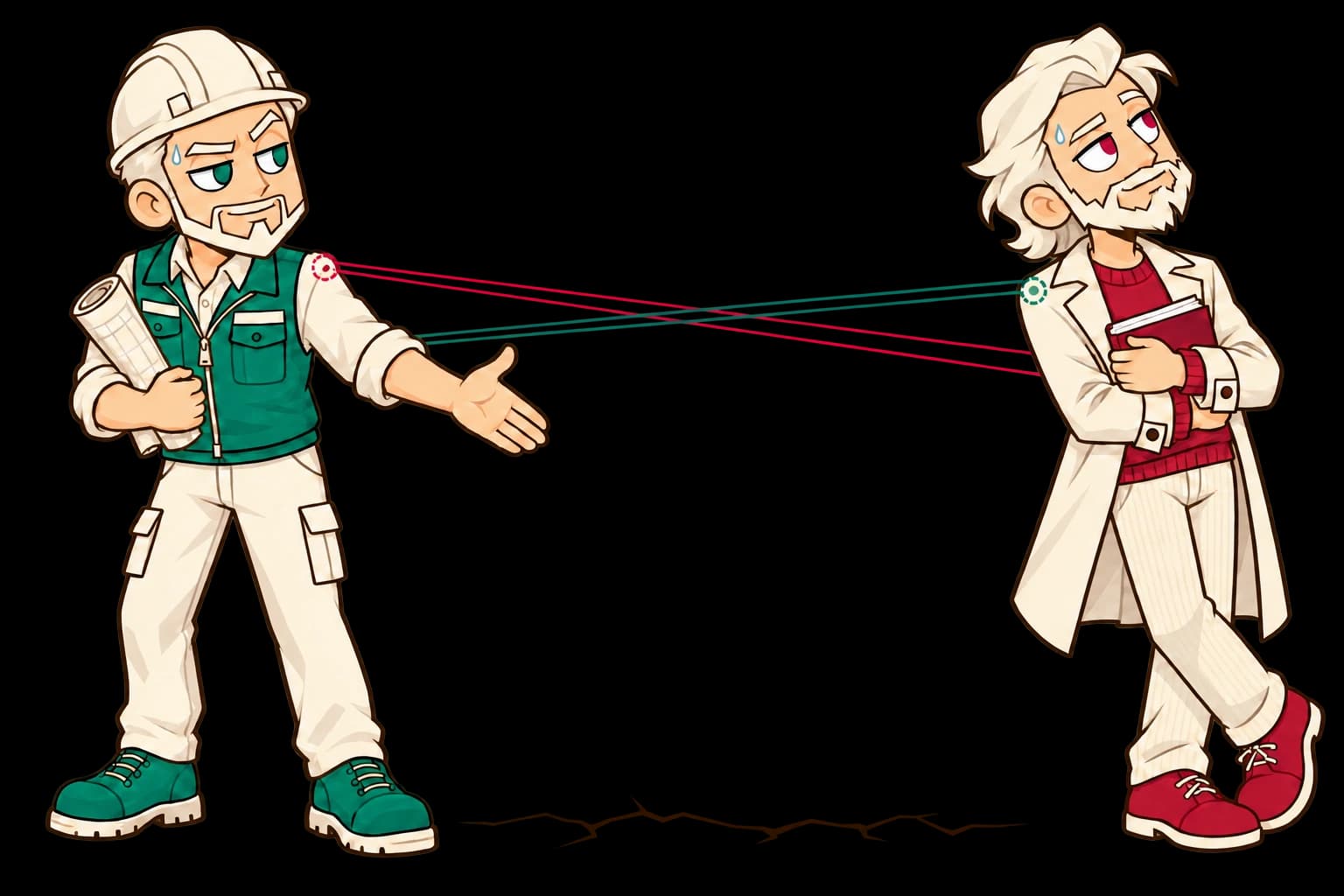
Mutual respect at a distance, mutual caution up close. Each sees in the other what they feel they should be, but cannot quite manage.
You can often recognize this relationship by how it feels before you know its name. The first meeting brings admiration: “They can do so easily what I have struggled to imitate.” The conversation is polite, and the respect is sincere on both sides. But after several hours together, or weeks on the same project, a strange tiredness sets in. Each person tries to present their best self. Each occasionally says something that, without meaning to, touches the other’s weakest point. And each waits for something from the other that never arrives.
This is called the “Super-ego” relationship. The unusual name describes the basic idea: what one person lives naturally and effortlessly is exactly what the other feels they ought to be, but cannot manage. The two types come from opposite quadras, so they share none of their central values. Yet they match on two of the four dimensions used to describe the sixteen types: energy direction and rhythm. Both are either extraverted or introverted, and both are either decisive or flexible. There are eight such pairs.
The strange thing about this relationship is that its best side is easier to see from a distance, while its hardest side appears up close. From afar, each sees in the other an image of what they wish they could be, and genuine respect grows. Up close, that image becomes a daily standard. Simply being there reminds each person of something they cannot do well, while the other’s practical approach can touch their weakest point in ordinary situations. Think of a role model who inspires you from afar but becomes tiring when they live next door. This image of the distant role model will help explain what can seem puzzling about the relationship.
The nature of the relation
The relationship can be summed up in one sentence: what each person lives as their core is what the other has to perform in public, while the way each person acts in practice lands on the other’s weakest points. This idea draws on the eight aspects of personality described in “How to Read the Relationship Pages.” Every relationship is a particular way these aspects meet. In the Super-ego relationship, each person’s strongest aspects meet the other’s weakest ones: sometimes as an example to follow, and sometimes as pressure that is hard to bear.
What sets this relationship apart is that what reaches each person easily comes in two opposite forms. A person’s social role receives the partner’s core: a steady stream from someone who lives that side without effort. This creates admiration and pressure at the same time. The person’s hidden need, however, receives only what the partner does not value. Meanwhile, each person’s practical tool lands on the other’s vulnerable point, and each person’s quiet skill lands on what excites the other.
The best of this relationship is easier to see from a distance; the hardest part appears up close.
One person lives naturally what the other has to perform
What meets here: One person’s core and the other person’s social role.
The first effect is sincere admiration. Someone who struggles to appear organized meets a person who lives order as naturally as breathing. Someone who works hard to seem warm at social events meets a person whose warmth comes without effort. Someone who tries to appear decisive meets a person who can settle a situation with a look. Each may describe the other with admiration: “They can do what I can’t.” This shows up in small details. One watches how the other walks into a room full of strangers and starts a conversation within seconds, or says no without spoiling the mood. They remember the example and try to copy it. The learning is real: many people develop a weaker side by spending time with someone who lives it naturally.
The second effect is less comfortable: the other person’s presence becomes a standard. When you work hard at something and see someone else do it effortlessly, you can feel measured against them whether you want to be or not. This explains something both people notice but may not understand: each makes more effort in the other’s presence than they do with other people. They arrange their words and pay attention to an appearance they do not usually maintain, then leave the meeting tired even though nothing obvious happened.
A practical approach that touches a vulnerable point
What meets here: One person’s tool and the other person’s vulnerable point.
The hurt comes through small, repeated moments. Someone who handles things by analyzing them and sorting them into categories can leave a partner who cannot bear that kind of talk feeling trapped. Someone who deals with things by talking about feelings and loyalties can embarrass a partner who does not know how to respond. Direct pressure can unsettle someone who cannot manage confrontation. Opening up possibilities and delaying a decision can worry someone who needs certainty.
The important detail is that neither person means harm. Each uses what they do best and believes they are helping or making things clearer. The other person may not be able to explain what upset them because it happened in an area where they have no words or arguments. After this happens repeatedly, each can form an unfair impression: “They know exactly where it hurts and do it on purpose.” In fact, the person may not even know that this is a painful spot.
A need that neither person notices
What meets here: One person’s hidden need and what the other person is good at but does not value.
The partner is quite capable of giving what is needed, but sees no reason to give it. Both can end up feeling a kind of dryness. Someone who needs reassurance about the future gets a short answer that closes the subject, then the partner moves on. Someone who needs open affection finds that the partner sees it as nothing worth making a fuss about. Someone who needs a clear explanation finds that the partner dismisses abstract discussion and asks for the result. There is no ill will here; the two simply differ on what deserves attention.
This has a lasting effect: the relationship may stop at respect instead of becoming a place of ease. People feel at ease with someone who meets a hidden need without being asked. However much they respect a person, they may not feel at ease when that person treats the need as an unimportant detail.
A quiet skill that sparks admiration
What meets here: One person’s quiet skill and what excites the other.
This is where some of the relationship’s happiest moments come from. Each sees the other casually do something they themselves wish they could do: solve a practical problem in minutes, change the mood of a room with one sentence, handle a difficult situation with confidence, or notice something in people that others miss. These moments help both people value each other’s company despite the tiredness, and they become some of their best memories together.
But these are moments, not a steady atmosphere. They happen now and then. The person who provides them may not even realize they have given anything, and cannot call them up on purpose. People who know this relationship often sum it up in one sentence: “A few wonderful moments, with tiredness in between.”
What they share and where they differ
- ValuesThe two people belong to opposite quadras, so they share none of their main values. What one sees as the heart of life, the other sees as secondary. What one does not care about may be what the other lives for. Time together may soften the distance between them, but it does not erase their different ideas of what matters.
- InterestsThey stand at opposite ends of the interest spectrum, so they care about different subjects and talk about different things. This keeps their conversations fresh, which can make short meetings enjoyable. Long conversations are harder because each has to explain their world from the beginning each time.
- Rhythm and energy directionThey match on both, but the effects are different. Matching in rhythm prevents clashes over timing and makes practical cooperation possible despite the differences described above. Matching in energy direction makes the differences more intense instead of balancing them. If both are extraverted, they compete for the same space and each may complain of not getting enough attention. If both are introverted, each retreats into their own space, so attempts to get closer can feel intrusive even when they are kind.
How it changes with closeness and time
No relationship stays at one distance or remains the same over time.
By distance
- From a distance
The relationship seems polished. They meet at an event or meeting, each sees something the other can do that they cannot, and they exchange sincere respect and polite conversation. Many such relationships stay at this distance for years—a neighbor or a colleague in another department—and each continues to speak well of the other.
- At a moderate distance
The friction first appears when they work together and have to carry out tasks every day. Each person’s practical approach starts to press on the other. Still, cooperation can work well if responsibilities are divided clearly and each is allowed to do the work in their own way without being second-guessed.
- Up close
The costs build up: constantly performing in front of someone who reminds you of what you cannot do, small moments that touch sensitive spots, and important needs that the other person does not notice. This does not make a close relationship impossible—many people manage it successfully in family life and at work—but it does call for separate spaces, clear rules, and open appreciation. What helps most is sharing fewer decisions, not discussing every decision at greater length. If each person knows in advance who decides about money and who decides how the home is arranged, there are fewer moments when their different approaches collide.
Over time
- The first meeting
It usually goes well. Both leave with a strong, positive impression: “They’re interesting,” or “They have something I don’t.” That impression is genuine, and it comes from each person’s strongest side—the same side that may tire the other later on.
- Getting closer
Tiredness appears early. Conversation takes effort, they have only a limited number of shared subjects, and small remarks can leave a surprisingly strong mark. People often take this as proof that the relationship cannot work. It may instead mean they are trying to live it at the wrong distance.
- Settling into a pattern
The relationship often finds a polite distance: open respect, cooperation within limits, and brief meetings from time to time. It can stay pleasant for years as long as that distance is respected. Tension returns whenever they are required to be closer, through sharing a home, a long project, or becoming family by marriage.
- Over the long term
This can be one of the most useful relationships for correcting a person’s view of themselves, because each person sees a whole world they do not know. It is likely—though not the only possible explanation—that someone who experiences the relationship with awareness develops a real skill in the area they usually have to perform, as long as they treat their partner as an example rather than a standard to measure themselves against.
How each sees the other
The same relationship can feel different from each side. The difference here does not come from two fixed roles—the pattern between them is symmetrical—but from the moment. In any given situation, one person may be admiring what they see while the other is feeling the impact of the partner’s approach on their weakest point. They can switch positions several times in a day.
The person who sees in the other what they wish they could be
This person stands in front of a living example of what they are trying to do. They see their partner do effortlessly what they had been preparing for since the night before. They admire them sincerely and try to learn.
Their particular risk is that admiration turns into self-criticism. They compare themselves with their partner in an area that is not really their strength, work so hard to keep up that they become exhausted, and then explain their tiredness by saying the other person is “a lot to deal with.” It is better to take from the example what is useful and remember that their own value lies in a completely different area. Their partner also admires them in that area.
The person whose vulnerable point is touched by the other’s tool
This person is in a position that is harder to describe than to experience. Nothing obvious has happened—just a remark or a passing question—yet they feel sharply uncomfortable and want to end the conversation. They cannot say what upset them because it landed in an area where they have no words or arguments.
Their particular risk is assuming bad intent. They may think their partner is deliberately embarrassing them or acting superior, then respond sharply in a way that completely surprises the other person. It is better to name the problem simply and without accusation: “This kind of conversation throws me off. Let’s handle it another way.”
When both accounts are taken together, we can see what makes the relationship useful despite its cost: each person carries, in their most natural way, an answer to a question that has occupied the other throughout their life. This is why the relationship works best in a limited form—a consultation, a friendship with plenty of space, or a short period of cooperation—and becomes harder when asked to provide the atmosphere of everyday life.
The relation across areas of life
Friendship
This is more often a friendship based on respect than on closeness. The friends meet from time to time, and each brings news from a different world and advice about an area the other does not know well. The friendship is especially useful at turning points. When someone needs an opinion from outside their usual circle, this friend may see something that no one similar to them can see. Many people keep a friend of this kind as “the other point of view” to consult when something important comes up.
The limit is that long meetings tire both people. After two or three hours, each may feel they are working hard to keep the conversation going, and small comments begin to hit sensitive spots. The best version is a short, regular meeting—coffee once a month, for example—not daily companionship.
Romance and marriage
The relationship often begins with strong attraction. Each sees in the other something that completes their picture of themselves, and the first months may be full of genuine mutual admiration. Then everyday life together puts the relationship to the test. A shared home means constant contact with someone who reminds each person of what they cannot do well, repeated small situations that touch sensitive spots, and deep needs the partner overlooks because they do not see them as important.
The fact that their values are completely different makes this harder. What one considers necessary spending, the other considers wasteful. What one sees as commitment, the other sees as going too far. Successful marriages do exist, and they tend to rely on three things: clearly separate spaces, an open agreement to divide responsibilities according to ability rather than expectation, and appreciation spoken out loud, since little is communicated automatically between them.
Work and cooperation
At work, these two can make a strong team in one particular arrangement: responsibilities are clearly divided and each works in their own area. Together, they cover a wide range that few other pairs cover, because what one person misses is exactly what the other notices.
The limit is that close, day-to-day teamwork is costly. Each person’s tool can hit the other’s vulnerable point in the details, and neither finds the support they need from the partner. Workplace hierarchy needs special care. A manager who asks an employee to work the manager’s way puts them on their weakest ground every day. An employee judged by the manager’s standards can look inadequate even while giving everything they have. It is better to agree on results and leave the method open, and to express appreciation directly because respect is not always understood without being said.
When they disagree
Every relationship has its own pattern of disagreement. In this one, conflict tends to pass through three stages.
- The spark
It usually begins with a small practical situation rather than a major issue: a remark about someone’s method, a suggestion made in a way the other cannot tolerate, or a question that lands on a vulnerable point. A second spark comes from an ignored need. One person asks for reassurance, open affection, or clarity and receives a short answer that makes them feel what matters to them is not worth the time. Because their values are so different, neither has a shared language for explaining why they are upset.
- Escalation
The argument develops according to their energy direction. If both are extraverted, voices rise, accusations come faster, and each complains that the other pays too little attention. If both are introverted, a heavy silence settles in and each retreats to their own space. In either case, the disagreement takes place in an area where they do not share the same vocabulary. What one considers a principle they cannot compromise on may seem like misplaced exaggeration to the other.
- A way out
The solution is not persuasion but arrangement: agree on clear boundaries—who decides in which areas, and how feedback should be given. Returning to a little distance can do what conversation cannot. When they step back slightly, they quickly regain the respect they had for each other, because that respect is real and only needs enough space to be protected. It also helps for each to say plainly what they value in the other. In this relationship, what goes unsaid often fails to reach the other person.
The relation in each pair
All eight pairs follow this general pattern, but what they exchange differs from pair to pair:
ILE lives by seeing possibilities, which SEE has to perform when facing the unknown. SEE lives by taking charge of a situation, which ILE has to perform when trying to seem decisive. ILE’s logical structure touches SEE’s weakest points, while SEE’s loyalties and personal appreciation touch ILE’s. Each excites the other without trying: ILE’s quick accomplishments and SEE’s social warmth. Both are extraverted, so they compete for the same space and may each complain that the other gives too little attention.
SEI lives by comfort and harmony, which ILI has to perform by taking care of the details of daily life. ILI lives by reading where things are headed, which SEI has to perform when asked about the future. SEI’s ability to set a mood touches ILI’s weakest points, while ILI’s cool, practical criticism touches SEI’s. Each quietly excites the other: SEI’s steady loyalty and ILI’s skill at arranging ideas. Both are introverted, so attempts to get closer can feel heavy even when they are kind.
ESE lives by the warmth of social life, which LIE has to perform when trying to stir enthusiasm in others. LIE lives by efficiency and results, which ESE has to perform when asked to calculate. ESE’s attention to comfort touches LIE’s weakest points, while LIE’s warnings about what is coming touch ESE’s. ESE needs logical clarity, which LIE may dismiss as overthinking; LIE needs quiet loyalty, which ESE may dismiss as keeping a distance. Both are extraverted, so respect can sometimes turn into competition for attention.
LII lives by building logical systems, which ESI has to perform when setting an abstract standard. ESI lives by personal bonds and moral judgment, which LII has to perform when talking about affection and loyalty. LII’s opening up of possibilities touches ESI’s weakest points, while ESI’s decisiveness and willingness to confront touch LII’s. Each quietly excites the other through what they do in the background: LII’s calm sense of where things are headed and ESI’s care with everyday details. Both are introverted, so long silences between them may sometimes be mistaken for conflict.
EIE lives by stirring emotions and giving things meaning, which LSE has to perform at social events. LSE lives by achievement and doing things well, which EIE has to perform when asked for concrete results. EIE’s dramatic expectations touch LSE’s weakest points, while LSE’s focus on practical details touches EIE’s. EIE needs a clear framework, which LSE may dismiss as theorizing; LSE needs personal loyalty, which EIE may dismiss as silent distance. Both are extraverted, so arguments can flare up quickly and take longer to cool down.
LSI lives by rules and discipline, which EII has to perform when analyzing and sorting things into categories. EII lives by conscience and personal bonds, which LSI has to perform when taking people’s feelings into account. LSI’s firmness and pressure touch EII’s weakest points, while EII’s uncertain possibilities touch LSI’s. Each quietly excites the other: LSI’s attention to everyday details and EII’s calm sense of what lies ahead. Both are introverted, so they may live with a quiet tension that lasts a long time.
SLE lives by strength and taking initiative, which IEE has to perform when trying to be decisive. IEE lives by seeing possibilities in people, which SLE has to perform when opening up to something new. SLE’s strict structure touches IEE’s weakest points, while IEE’s personal appreciation touches SLE’s. Each excites the other without trying: SLE’s practical competence and IEE’s warmth with people. Both are extraverted, so long meetings can turn into a contest over who leads the room.
IEI lives by sensing timing and meaning, which SLI has to perform when asked what will happen. SLI lives by comfort and doing things well, which IEI has to perform when managing the details of the day. IEI’s emotional coloring of a situation touches SLI’s weakest points, while SLI’s practical calculations touch IEI’s. Each quietly excites the other: IEI’s personal loyalty and SLI’s logical order. Both are introverted, so long stretches of comfortable silence may be interrupted by sudden moments of distance.
















What can change its course
The pattern above is how the relationship tends to work when other factors are equal. Four factors can shift it.
- SubtypeA harmonizing subtype can soften the friction considerably because it tends to soften what it says and avoid hitting sensitive spots. An organizing subtype can do this alongside a dominant one. Two dominant subtypes from opposite quadras make the hardest combination: mutual insistence, opposing values, and vulnerable points being touched every day.
- Whether the core or the tool is strongerWhen the core is stronger, a person inspires their partner more in the area the partner has to perform, and touches their vulnerable points less because their tool is quieter. When the tool is stronger, they are more involved in the details, so small hurts happen more often. A pair in which both people have a stronger core tends to feel more admiration and less friction.
- Maturity and experienceThis relationship often improves with maturity because much of its tiredness comes from comparing yourself with the other person. Someone who has settled into their own area does not feel threatened by a partner who is skilled in a different one; they can enjoy learning from them. Someone still trying to prove themselves may read the other’s presence as a constant challenge and wear themselves out through comparison.
- A third personA third person can ease the tension here more than in almost any other relationship. They break up the two-person comparison and may meet a need that neither partner can meet for the other. This is why the relationship often works better in a team or group than in an isolated pair, and better in a large family than in a small household.
Strengths and friction
Strengths of the Super-ego relationship
- Sincere mutual admirationEach sees in the other what they wish they could be, creating respect without pretense that can last for years. The limit is that, up close, this admiration can become a daily standard against which each measures themselves.
- A living example in a difficult areaEach can learn by watching what advice alone has not taught them, because the other lives it effortlessly. The limit is that learning by watching takes time, and long comparisons can create a sense of inadequacy.
- Broad coverageWhat one person misses, the other notices, so together they cover more ground than a similar pair. The limit is that this works only when responsibilities are divided openly; otherwise, the difference becomes a source of conflict.
- Enjoyable moments that happen naturallyEach does something in the background that excites the other, giving them wonderful moments they remember for a long time. The limit is that these moments are scattered and cannot be summoned on purpose.
- A similar rhythmThey agree on how quickly to decide and how to handle timing, so practical arrangements go smoothly. The limit is that this cannot make up for their different values, which are their deepest point of separation.
Possible sources of friction
- Small repeated hurtsIn everyday situations, each person’s tool lands on the other’s weakest point, creating discomfort without an obvious reason. This is less likely when they name it simply: “This way of talking throws me off. Let’s handle it differently.”
- A need met with a short answerEach asks for what they need and gets a quick, correct response from a partner who does not see it as important, leaving them feeling unheard. This is less likely if they agree to meet some requests because they matter to the person asking, even when the other person does not find them convincing.
- Constant effort becomes tiringEach tries harder in the other’s presence than with other people and leaves tired without knowing why. Short, well-spaced meetings can help, as can agreeing to let go of the effort to impress each other.
- Opposing valuesOne person’s priority seems excessive to the other, and they have no shared language for discussing it. This is less likely when they divide decisions by area instead of trying to agree on the underlying principle.
- Competition or intrusionTwo extraverts compete for the same space and complain of not getting enough attention. Two introverts may find the other’s approach heavy, even when it is kind. This is less likely when each person’s space and meeting times are clearly understood.
How to make it work
Good intentions alone are not enough. Small habits can address particular sources of friction.
- Name discomfort without blameWhen a partner’s approach touches a sensitive spot, say so plainly: “This kind of conversation throws me off.” This can save both people from a cycle of suspicion, because the other person may not know that they touched a painful point.
- Meet a request without requiring the other person to agreeAgree on a rule: if one person asks for something because it matters to them, the other will try to meet the request even if they do not consider it important. The disagreement is not about whether the request is right, but how much it matters—a question that argument alone cannot settle.
- Protect the distanceThe relationship works best when meetings are brief and regular rather than long and constant. This does not make the relationship less meaningful; it recognizes the distance at which it can offer its best.
- Divide areas instead of trying to agree on principlesWhen their values differ, it is often better to divide the decision: “You decide this area by your standards, and I’ll decide that one by mine.” Trying to find a shared principle can use up their energy without getting them anywhere.
- Say what you appreciateIn this relationship, what is left unsaid may not reach the other person, because each gives things naturally and may not realize it. One direct sentence—“I’m learning from you in this area”—can change the whole atmosphere.
Telling it apart from similar relations
Three relationships can be confused with the Super-ego relationship in everyday life. Each has a question that helps tell them apart.
Kindred
Like the Super-ego relationship, each person’s tool touches the other’s weakest point, and each person’s quiet skill excites the other. The difference is in their core: in a Kindred pair, they see the world from the same angle and agree on the direction, even if they disagree about the route. Here, they differ on the direction itself.
The key question: “When their way of doing things hits your weakest point, do you at least agree on where you are going, or do you disagree about that too?”
Business
Like the Super-ego relationship, what each person lives naturally is something the other has to perform, so they admire and learn from each other. The difference is in their tools: in a Business pair, their methods match, making shared work the easiest part of the relationship. Here, each person’s tool lands on the other’s weakest point, making shared work the hardest part.
The key question: “When you work together, do you have the same tool in hand, or does their tool hit one of your weakest points?”
Conflict
Like the Super-ego relationship, the pair has opposing values and different interests, and small remarks can hit sensitive spots. The difference is where the impact lands: in a Conflict pair, each person’s core—their very presence—presses on the other’s weakest points, creating constant pressure without any action. Here, each person’s core lands on something the other has to perform, creating admiration and tiredness rather than pressure.
The key question: “Do you respect them from a distance and find them tiring up close, or are you drawn to them at first and then find that their mere presence puts you under pressure even when they do nothing?”


Conclusion
Accounts of this relationship often describe genuine mutual respect alongside difficulty in close daily life. It tends to work well when the people keep some distance. Both may feel tired after long meetings even when no obvious argument took place. Extraverted pairs may complain that they do not get enough attention, while introverted pairs may complain that the other intrudes. The way the types work together offers one explanation: admiration comes from each person’s core landing on the side the other has to perform, so each sees an image of what they are trying to become. Small hurts come from each person’s tool landing on the other’s weakest point. The feeling of dryness comes from each person’s deep need landing on something the partner can do but does not value. It remains possible—though it would need to be checked by comparing people who have lived this relationship for years with those who have not—that a long experience of it helps people develop the side they usually have to perform.
What may have seemed like many separate details comes back to one pattern: each person’s strongest aspects land on the other’s weakest ones, sometimes as an example to follow and sometimes as a way of acting that is hard to bear. This brings sincere admiration, unexplained tiredness, a need neither person notices, and enjoyable moments that come now and then.
This explains some of the contradictions that puzzle people in this relationship: the person they admire most may also tire them most; the partner may give them something valuable without realizing it; and they may feel closest when they are farthest apart. They match in rhythm, differ in values, and each learns from the other something no one else can teach them.
From the outside, this may look like mutual respect between two people who have little in common. From the inside, it is like having a role model who lives closer than is comfortable: inspiring from a distance, tiring as part of everyday life.
What your relationship needs is not for either of you to become like the other, or to agree on something you will never agree on. It needs you to find the distance at which it brings out the best in both of you, and to say out loud what you value in each other. A distant role model can remain a role model as long as there is enough distance to see them clearly.
This description applies to every pair in a Super-ego relation.Browse the fourteen relation types