


They talk about the same things in languages so similar that the difference is easy to miss. They agree on the subject and disagree about everything it means.
You can recognize this relationship by its effect before you know its name. A meeting begins with relief: at last, someone who cares about the same things, reads the same material, and knows the details of this field. The conversation then runs smoothly for a long time. When it ends, though, each person is left with a strange impression: they spent two hours discussing the same subject and came away with opposite conclusions. There is no quarrel or anger, only confusion. How can two people agree on every detail and disagree about what it all means?
This relationship is called Quasi-identity. It pairs two types from opposite quadras. They do not share their major values, yet they share the same area of interest and energy orientation. They differ in rhythm: one is decisive and the other flexible. There are eight such pairs. It is easy to assume that a shared interest is enough for deep understanding. This relationship is clear evidence that caring about the same subject and agreeing on what it means are two different things.
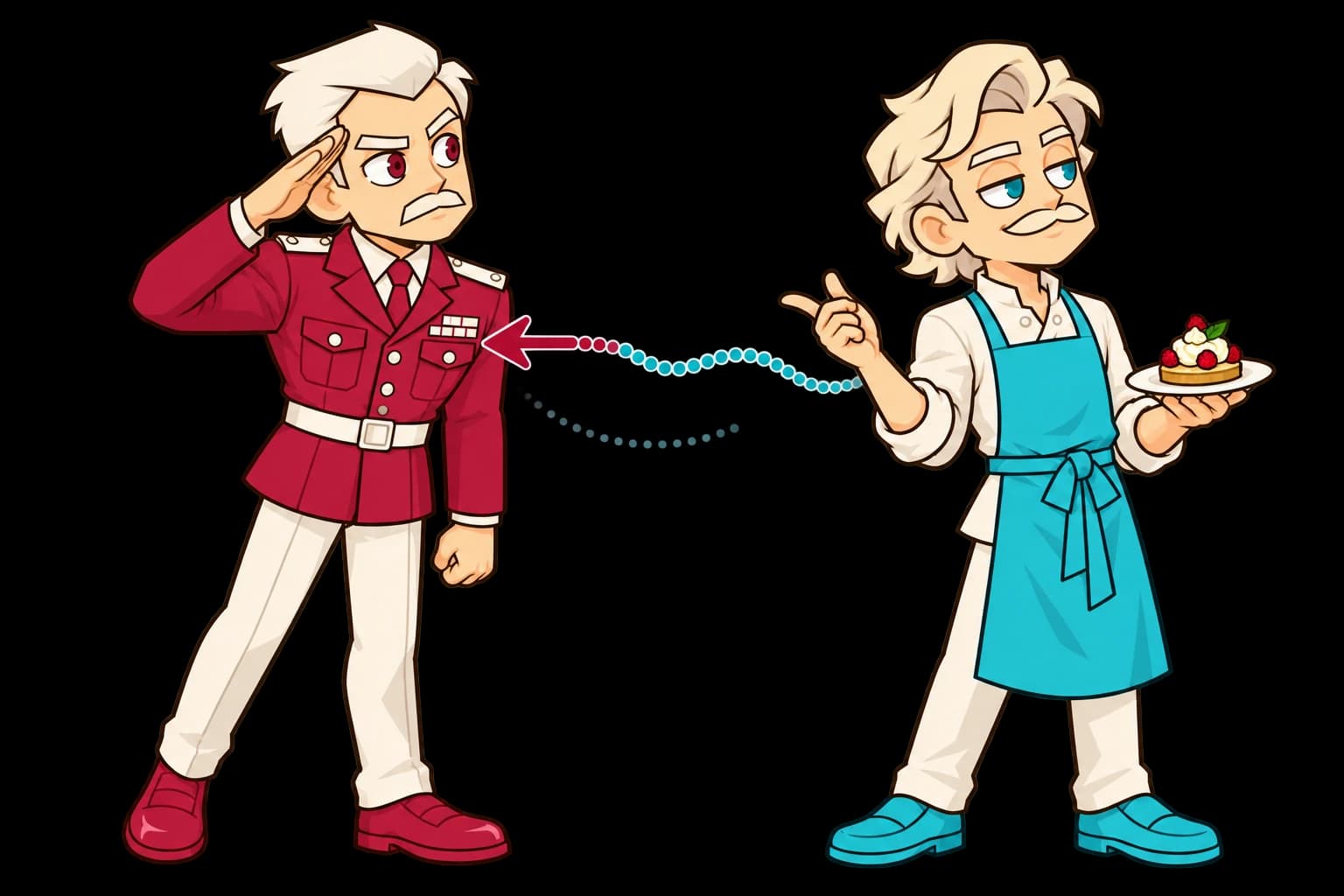
The strange part is that the surface similarity hides the deep difference. If the two people had different interests, each would know that the other needed a longer explanation. Instead, they use the same words for the same subjects, so each assumes the other means what they mean. They discover the difference only later. Imagine two people measuring the same room, one in meters and the other in feet. They agree that it is spacious, then disagree about every number. Each thinks the other measured incorrectly, although neither did. No one asked which unit they were using. This image—one thing measured in two units—will return whenever it helps explain what seems puzzling here.
The nature of the relation
Quasi-identity rests on one idea: the two people are skilled in roughly the same areas, but what one takes completely seriously the other handles in the background, almost as play. This involves the eight aspects of personality explained in “How to Read the Relationship Pages.” Every relationship between two types is a particular way these aspects meet. In Quasi-identity, aspects of equal strength but opposite value face one another: what is most precious to one person matters least to the other, and vice versa.
What sets this relationship apart is that nothing either person offers reaches an easy channel in the other. Each person’s tool lands on an area the partner is good at but dismisses, while their quiet skill lands on the partner’s steady core. What does reach the easy channels does not come from what the partner is offering: what each person has to perform in public meets what excites the other, while each person’s hidden need meets the other’s vulnerable point. The result is that everything one person says is judged by the other using a different standard. Even if they wanted to, neither could deeply wound the other.
They resemble you enough to make you forget that they are measuring with a different unit.
What One Takes Seriously, the Other Treats Lightly
What meets here: each person’s core with the other person’s quiet skill.
One person may treat something as the mission of their life, while the other does it while thinking about something else. This creates mutual misjudgment that can be almost funny. The first person sees their partner wasting in casual play something worth building a life around. The second thinks their partner is making too much of a simple matter. It shows up in small moments: one speaks about a project they see as the work of their life, and the other lightly replies, “That’s nice. I do something similar in my spare time.” Both are sincere. They work in the same area and have similar ability; the difference is the place this area holds in each person’s life.
This has an important effect: praise does not land. When one person praises the other in this area, the praise falls on something its recipient does not value and passes without effect. Criticism falls on the recipient’s steady core and passes just as easily. From the outside, the relationship can therefore look unresponsive: lots of talk, little effect.
A Method the Other Person Thinks Is Wrong
What meets here: each person’s tool with an area the partner is good at but dismisses.
Here, a person is not presenting their method to someone unfamiliar with it, but to someone who has tried it and does not trust it. The result is polite, endless criticism in both directions. One person explains how they completed a task and hears something like, “That’s a valid method, but it takes more time than it’s worth,” or, “I used to do that too, then I stopped.” One suggests a carefully ordered, step-by-step solution; the other says it is quicker to try things directly and correct them along the way. Each person is right by their own standard, and neither is willing to replace that standard.
There is a positive side to this exchange: each person can see the limits of their method through the other. Someone used to measuring everything by the result hears from someone who measures it by consistency, and vice versa. This helps a person who can hear it as another point of view rather than a judgment of their worth.
What One Has to Perform Excites the Other
What meets here: what each person has to perform in public with what excites the other.
What one person has to perform—the weakest part of what they show—meets what excites the other, in both directions. This creates a few pleasant moments at little cost. When one person tries to be decisive or cheerful, even though it takes effort, their partner responds more warmly than they expect. The partner values that quality and is glad to see it. This is one of the relationship’s welcome surprises: someone notices and appreciates an effort that other people overlook.
The limit is that both people are weak in this exchange. The giver offers one of their weaker sides, and the receiver appreciates a quality they do not themselves master. These moments remain pleasant and light; they cannot serve as the foundation for a relationship.
A Need That Meets a Vulnerable Point
What meets here: each person’s hidden need with the other’s vulnerable point.
At a deep level, each person needs precisely what their partner cannot provide, so the need remains unmet. Someone who needs a partner to look after their comfort finds a partner who is awkward around those matters. Someone who needs decisiveness finds a partner who gets tense during confrontation. Someone who needs openly expressed warmth finds a partner who does not know how to create it. However long the relationship lasts, neither gets the feeling that the other is supporting them where they are weak.
The second result is quieter than expected: neither person hurts the other in their sensitive place, because the partner lacks exactly the weapon that could strike it. Their disagreements stay cool and clean: much talk about the right method, little personal hurt. Many of these pairs remain peaceful for years, with each person describing the other as “a decent person; there’s no problem between us.” That description says everything about the relationship, including what it lacks.
What They Share and Where They Differ
- ValuesThe two people belong to opposite quadras, so they share none of their major values. What one person sees as an end, the other sees as a means; what one sees as the heart of the matter, the other sees as a detail. That makes it difficult to reach a shared conclusion even when they agree on the facts.
- Interests and rhythmHere is the similarity that misleads them: they are in exactly the same area of interest, so they connect easily and talk at length. At first each may think they have found someone like themselves. Their rhythm differs, however. One wants to close the matter and act; the other wants to leave it open until the picture becomes clearer. This shows up most in plans and decisions.
- Energy orientationThey share it. If both are extraverted, meetings fill with conversation and long discussions. If both are introverted, the relationship is quieter, with a calm exchange of observations. In either case, neither person balances the other, so their shared tendency toward more speech or more silence is amplified.
How it changes with closeness and time
No relationship stays at one distance or remains the same over time:
By distance
- From a distance
The relationship looks promising. The two people meet at a seminar or professional event, find someone who knows the field and speaks its language, and talk for a long time. This is often the best distance for Quasi-identity: two people who know the same field exchange views from opposite sides.
- At a middle distance
What the first meeting did not reveal becomes clear. Working together shows that one person wants to settle the matter while the other wants to keep it open, and each sees the other’s method as one they tried and abandoned. Cooperation requires constant translation from one unit to the other: each person has to restate what they understood to make sure it matches what was meant.
- Up close
The relationship remains calm and free of deep wounds, but its emptiness becomes visible. Each person needs something the other does not have and gets no support from them in the area where they are weak. Many describe life together as “comfortable and cold.” Closeness calls for more clarity, not more conversation: each person should state what they need directly. Their partner does not pick up hints, because hints arrive with another meaning, but will respond to a clear request if they can.
Over time
- At the first meeting
It is comfortable. Shared subjects appear right away; both know the details, and each gets the impression that the other “knows this field.” One may think they have found someone like themselves, though that impression will change.
- As they grow closer
Confusion begins. Each discovers that their partner reaches the opposite conclusion from the same details, and that what they see as the foundation of the issue seems marginal to the other. They begin correcting each other’s methods, and both find themselves explaining more than expected.
- As the relationship settles
It settles into quiet respect: polite discussion, limited cooperation, and a silent decision not to persuade the other. They rarely quarrel and rarely grow close. The relationship stays on a stable level that neither rises nor falls.
- Over the long term
It is among the easiest relationships to continue without problems, and among those with the least effect on a person’s life. It does not exhaust or support, hurt or heal. Its real value may lie in one area, though this is not the only possible explanation: for someone willing to examine their beliefs seriously, it is the best source of a view of the same issue from the other side.
How each sees the other
The same relationship does not look identical from both sides. The clearest difference here comes from rhythm: one person wants matters decided and closed; the other wants them to remain open until they are ready.
From the Decisive Person’s Side
The decisive person comes wanting a conclusion: What will we do, when will we do it, and by what standard will we judge success? They find a flexible partner who knows the field well and offers smart observations, then, in their view, avoids making a decision and opens new lines of discussion whenever the conversation is about to end.
Their particular risk is reading this openness as hesitation or delay. They press for a decision, which makes the other person become even more open-ended. A better approach is to make a specific request: “I need one answer from you on this point; everything else can stay open.” This gives the decisive person a clear answer without making their partner feel pushed along.
From the Flexible Person’s Side
The flexible person comes believing that closing a matter too quickly means missing something that has not yet appeared. They find an organized and productive partner, then feel that the decisive person jumps to a conclusion before it is ready and insists on a standard that does not work in every case.
Their particular risk is delaying without limit and losing their partner’s trust, or going along with a decision and then backing away from it. A better approach is to set a deadline and keep it: “I need a week, and then I’ll give you a final decision.” This protects the time they need to arrive at a considered answer and the certainty their partner needs.
Where these accounts meet, we see what is distinctive about the relationship: it is one of the clearest mirrors for seeing limits that we cannot notice in ourselves. The partner knows your field as well as you do and sees what you see, yet reaches another conclusion. That alone can make you question the assumptions behind your view. Those who can tolerate that question grow; those who cannot leave thinking the other person “doesn’t understand.”
The relation across areas of life
Friendship
Friendship in Quasi-identity is a friendship of conversation. The friends meet around a shared interest, exchange news and analysis, and enjoy finding someone who knows the details. It asks little of either person: no reproaches and few expectations. That is why it can last for years in a workplace without personal conflict or becoming a friendship outside the office. This can be valuable in its own right; not every relationship has to extend beyond the place where it began.
The limit is that it stays in the realm of ideas. When one person needs real support in a crisis, they find a sympathetic friend who does not know how to help, because the needed quality falls on the other person’s weakest point. Someone who understands this can enjoy the friendship for what it offers—discussion and consultation—and seek support elsewhere.
Romantic Relationships and Marriage
Romance often begins calmly and comfortably: shared interests, an easy flow of conversation, and almost no conflict. That is enough at first and can be mistaken for compatibility.
Shared life brings a different test: not sharp disagreements, but an emptiness. Each person needs something the other does not have, leaving the need unmet for years without either knowing how to explain it. Their difference in rhythm also appears in every decision. Marriages that continue—many of them peacefully—do so by valuing what they actually have: a respectful partnership with little harm and good intellectual companionship. Two things help: neither person should demand what the other does not possess, and each should find what is missing in a wider circle instead of waiting for their partner to provide it.
Work and Cooperation
At work, this pair offers real value in planning and review. Each sees an issue from the other side, bringing out gaps that a more uniform team might miss. They are respectful colleagues who do not compete for the same ground because each values something different.
Their limit appears in joint execution: different rhythms delay decisions, and correcting one another’s methods takes time. The practical rule is to ask about the unit before arguing about the number. Each person should restate what they understood before building on it—“So you mean this?”—a simple habit that removes half their misunderstandings. It also helps to agree in advance on who has the decision at each stage. In a workplace hierarchy, this is one of the calmest relationships: the manager decides and ends the cycle of discussion, while the employee has a manager who knows their field and does not touch their vulnerable points.
When they disagree
Every relationship has its own pattern of disagreement. In Quasi-identity, conflict tends to pass through three stages:
- The spark
It begins with a misunderstanding rather than a clash of interests. One person means one thing by a word, the other understands something else, and a decision or position is built on that misunderstanding. A common second spark is a difference in rhythm: one person considers a matter settled and has begun acting, while the other believes it is still open for discussion. A third, milder spark is a comment that belittles the other person’s method, offered in good faith and received with annoyance.
- Escalation
The disagreement builds slowly and coolly. Each person explains their position in detail, offers evidence, and explains again from another angle—without reaching the other. The reason is that they disagree on the standard used to judge the facts, not on the facts themselves; more detail cannot settle that. The escalation stays polite because neither person has what it takes to hurt the other’s sensitive point. The disagreement becomes mental fatigue rather than a personal fight.
- A way out
The answer is to identify the unit, not to prove the number. The simplest step is for each person to restate the other’s position in their own words and ask, “Is that what you mean?” Often they find that half the disagreement was about understanding, not opinion. The next practical step is to agree on who decides each matter and set a final time to close the discussion.
The relation in each pair
The eight pairs share this pattern, but what they exchange differs from one pair to another:
Both talk about ideas and opportunities in nearly the same language. What ILE experiences as a life mission—turning possibilities over—LIE handles in the background while moving toward a goal. What LIE experiences as a mission—competence and results—is something ILE can do without seeing it as an end in itself. LIE sees detailed logical analysis as slowing things down; ILE sees the push for results as cutting corners. ILE needs someone to look after comfort, while LIE needs quiet personal loyalty, and each is weakest in what the other needs. Their meetings tend to become long discussions: similar ideas, opposite conclusions.
Both care about home, people, and the quality of details. What SEI experiences as their core—comfort and harmony—is something ESI quietly does without making it their goal. What ESI experiences as their core—loyalty and moral judgment—is something SEI can do without building their life around it. SEI sees confrontation as needless harshness; ESI sees atmosphere-making as watering down a position. SEI needs someone to open a new horizon, while ESI needs practical competence, and each is weakest in what the other needs. Their relationship resembles a friendly neighborhood: mutual respect and a distance that does not shrink.
Both move in the world of people, social occasions, and presence. What ESE experiences as their core—the warmth of shared feeling—is something SEE does well and uses as a tool. What SEE experiences as their core—presence and getting what they want—is something ESE can do without seeing it as an end. SEE sees constant hosting as wasted opportunity; ESE sees sorting people into categories as harsh. ESE needs logical clarity, while SEE needs a view of consequences, and each is weakest in what the other needs. Their meetings are crowded with social presence but short on mutual understanding.
Both think for a long time, read widely, and say little. What LII experiences as their core—a consistent logical structure—is something ILI uses as a tool. What ILI experiences as their core—reading how things will turn out—is something LII can do without making it the center of life. ILI sees opening more possibilities as distracting; LII sees judging everything by the result as too narrow. LII needs openly expressed warmth, while ILI needs a push and decisiveness; each is weakest in what the other needs. Their relationship tends toward serious conversation: mutual respect and lasting coolness.
Both engage with people, their potential, and their meaning. What EIE experiences as their core—stirring collective emotion—is something IEE does well and uses lightly. What IEE experiences as their core—seeing what each person could become—is something EIE can do without making it their aim. IEE sees a decision made on one fixed schedule as restrictive; EIE sees keeping many options open as superficial. EIE needs a clear logical framework, while IEE needs care for comfort, and each is weakest in what the other needs. Their enthusiasm runs in parallel: each is excited about something the other does not see.
Both are good at order, practical work, and saying little. What LSI experiences as their core—rules and order—is something SLI quietly uses as a means. What SLI experiences as their core—comfort and quality of life—is something LSI can provide without making it their goal. SLI sees enforcing rules and being forceful as extra effort; LSI sees the pursuit of comfort as laxity. LSI needs warmth in the atmosphere, while SLI needs a new horizon, and each is weakest in what the other needs. Their relationship is quietly disciplined: practical cooperation and long silences.
Both get things done, take the lead, and like results. What SLE experiences as their core—strength and presence—is something LSE uses when needed. What LSE experiences as their core—well-executed work—is something SLE can do without seeing it as an end. LSE sees imposing one’s will as wasted effort; SLE sees attention to details as slowing things down. SLE needs insight into future consequences, while LSE needs personal loyalty, and each is weakest in what the other needs. Their relationship resembles polite competition: both accomplish things, with little common ground.
Both live in a quiet inner world and care about people and meaning. What IEI experiences as their core—a sense of what is coming—is something EII uses as a supporting intuition. What EII experiences as their core—relationships and moral judgment—is something IEI can do without building life around it. EII sees coloring the mood as excessive; IEI sees opening up many possibilities as a distraction from a clear direction. IEI needs a push and decisiveness, while EII needs competence to organize their work, and each is weakest in what the other needs. Their relationship is mutually gentle: apparent understanding, but two worlds that do not meet.
















What can change its course
The pattern above is what tends to happen when other factors are equal. Four things can shift it:
- SubtypeA Dominant subtype in either person can add practical decisiveness—which this relationship lacks—while also increasing insistence on one’s own method. A Harmonizing subtype on the other side can soften that insistence. Two Harmonizing subtypes may make the relationship so polite that neither says what needs to be said.
- Whether the core or the tool is strongerA person whose core is stronger holds more firmly to their standard and finds it harder to see an issue by another standard. A person whose tool is stronger is more flexible about looking at the issue from another angle. A pair with strong tools on both sides tends to understand one another sooner and find compromises; a pair with strong cores can circle the same discussion without end.
- Maturity and experienceThe relationship improves when people learn that a difference in standards is not a mistake in logic. A mature person listens to the other angle as information about the world. Someone who is not yet mature hears it as a challenge to their correctness and spends time proving something that cannot be proved.
- A third person’s presenceA third person who stands outside both standards can be useful. They may notice that the two people describe the same event using different measures, ask each what they mean precisely, and reveal that half the disagreement concerns the measure rather than the event. This relationship works best in a team with someone who can play this role, and can go in circles when the pair is isolated.
Strengths and friction
Strengths of the Quasi-Identity Relationship
- Exactly shared interestsThey work in the same field, connect easily, talk at length, and do not need to simplify what they say. The limit is that similarity in subject hides a complete difference in standards, so they discover it late.
- Another angle on the same issueEach sees a familiar field from the opposite side, giving the other a rare chance to examine their assumptions. The limit is that this helps only someone who can bear the examination; someone who cannot may hear it as a denial of their worth.
- Protection from deep woundsNeither person has what it takes to strike the other’s sensitive point, so disagreements stay cool and clean. The limit is that this safety comes from inability, not care: neither harms the other, but neither protects them either.
- Similar competenceEach knows the other really does understand the field, creating genuine professional respect rather than flattery and allowing the relationship to last for years without reproach. The limit is that this respect may never become personal closeness.
- Unexpected pleasant momentsEach person appreciates what the other has to perform in public, an effort most people do not notice. The limit is that these moments are light and superficial; they cannot build a relationship by themselves.
Likely Sources of Friction
- One word, two meaningsThe same word reaches each person with a different meaning, and a mistaken understanding becomes the basis for a position or decision. This is prevented when each restates what they understood and asks, “Is that what you mean?”
- A discussion with no endThey circle the same issue without a conclusion because the disagreement is about the standard, not the facts. This is prevented by agreeing in advance on who decides and when the discussion will close.
- Mutual dismissal of the other’s coreEach person handles lightly something the other sees as the mission of their life, leaving both feeling that what they value most is not taken seriously. This is prevented by a simple rule: do not joke about what your partner takes seriously.
- An unmet needEach person’s need falls on the other’s weakest point, so the need can remain unmet for years without the person knowing how to explain it. This is eased when each looks for that quality in people who have it and stops waiting for their partner to provide it.
- Clashing rhythmsOne considers a matter settled while the other considers it open, delaying decisions and causing repeated surprises. This is prevented by stating in each matter whether something is a final decision or an initial view.
How to make it work
Good intentions alone are not enough. Small habits can address specific points of friction:
- Restate before building on what was saidOne habit can prevent half the relationship’s problems: each person restates in their own words what they understood before building on it. What sounds like agreement often hides a difference in meaning.
- Decide who decides and when discussion endsInstead of searching for a shared standard, agree on who makes each decision and set a deadline. Here, closure is procedural rather than intellectual.
- Respect what the other takes seriouslyEach person should avoid making a light comment about what their partner sees as the core of their life, even if they themselves handle it easily. This is the point most likely to hurt in this otherwise quiet relationship.
- Seek what is missing from someone who can provide itEach person should understand that their deep need falls on the partner’s weakest point and look for that need to be met by someone who has the relevant ability. This does not turn away from the relationship; it treats it fairly.
- Say whether a decision is open or finalIn every matter, say “This is an initial view” or “This is a final decision.” Many surprises in this relationship come from one person thinking a matter is closed while the other thinks it remains open.
Telling it apart from similar relations
Three relationships are close enough to Quasi-identity to be confused with it in everyday life. Each has a question that helps tell them apart:
Extinguishment
Like Quasi-identity, it involves the same field and no shared values, so in both cases the two people seem interested in the same things but reach different conclusions. The difference is that in Extinguishment each of you stands on the other side of the same issue, knows the other’s approach well enough to warn against it and dampen their enthusiasm, and competes in the same skill in public. Here there is no competition or dampening, only confusion about meaning.
Key question: “When you discuss the same subject, does the other person take the opposite side and compete with you in front of people, or do they use a different standard and disagree with your evaluations?”
Benefit, from the Benefactor’s position
It shares the fact that your core falls on the partner’s quiet skill and your need falls on one of their weakest points. The difference is that there your words reach them directly and affect them more than you expect, while what they say does not seem useful to you.
Key question: “Do you both use different standards, so neither gets through as intended, or do your words reach them directly while theirs do not reach you?”
Benefit, from the Beneficiary’s position
This is the reversed picture: their words reach you easily and are hard to resist; their approach looks like a model, while what you say seems to leave little effect on them.
Key question: “Do your words pass between you with equal difficulty, or do their words reach you like an instruction while yours seem to have no effect on them?”

Conclusion
Accounts of this relationship agree that it is calm and has little conflict. The two people share interests but reach different conclusions, need to explain repeatedly what seems obvious, and provide neither deep support nor deep harm. The way their types work helps explain this. Confusion comes from aspects that are equal in strength but opposite in value: the two people use the same words to mean different things. The protection from deep wounds comes from each person’s deepest need falling on the other’s weakest point. The limited impact comes from nothing one person offers reaching the channels through which the other is easily affected. It remains an open possibility—one that would need to be checked by observing teams that include such pairs and measuring misunderstandings before and after—that the habit of restating one another’s words noticeably reduces conflict.
The details in these pages come back to one movement: aspects of equal strength and opposite value meet between the two people. From that movement come the surface similarity, the difference in conclusions, the endless discussion, and the calm that does not wound.
That is where the relationship’s puzzles come from: the person most interested in what matters to you may be the least able to understand why it matters; the thing you value most may be something your partner does while thinking about something else; and your calmest relationship may have the least effect on your life. Similar in subject, opposite in meaning, they measure in two units while everyone assumes there is only one.
From the outside, the relationship may look like compatibility between two people with the same interests. From the inside, it is more like two rulers on the same table: both measure the same thing accurately and give different numbers. Their owners argue about the number and forget to ask which unit they are using.
What your relationship needs is not for you to agree on meaning or for one person to give up their standard. It is for you to practice one small step before building on what the other has said: restate it in your own words. What separates you is not distance between your hearts but a difference in meaning. Ask about the unit instead of arguing over the number.
This description applies to every pair in a Quasi-identity relation.Browse the fourteen relation types