

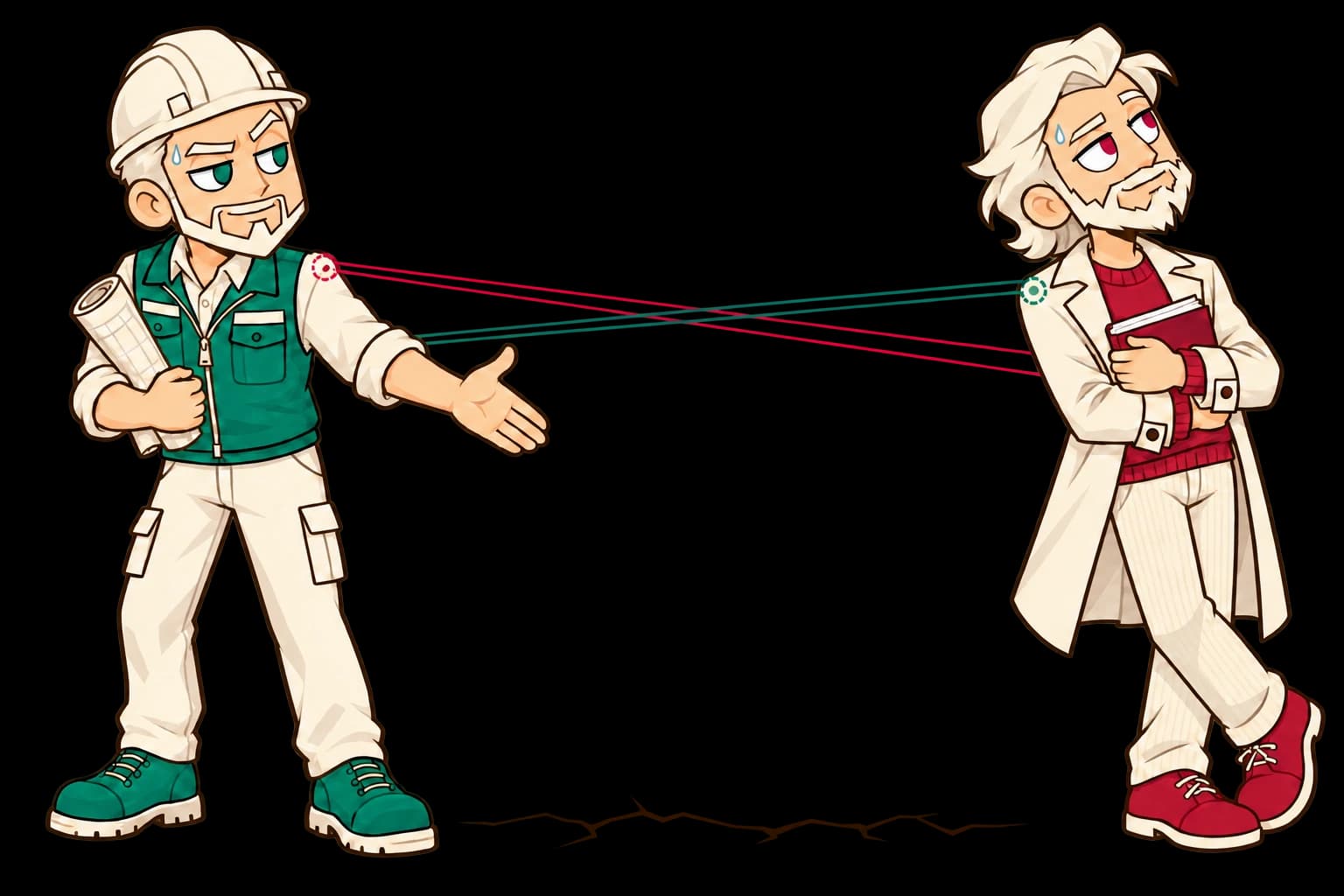
A promising beginning and quiet, unrelenting pressure. Each person hits the other’s weakest point simply by being themselves, and neither means any harm.
You can recognize this relationship by its effect before you know its name. The first meeting is striking: someone entirely different, who easily does something that takes effort for you and offers something you needed without intending to. For a few weeks, interest is mutual. Then, without any single event to point to, a sense of heaviness begins. An ordinary conversation ends in tension, an innocent comment lingers, and after every meeting one wants to get away. Neither can name exactly what they are complaining about, because what tires them is not an action but a presence.
This relationship is called Conflict. It pairs two types from opposite quadras that differ on all four dimensions used to describe the sixteen types: one is extraverted and the other introverted; one notices concrete details and the other possibilities; one judges by logic and the other by how things affect people; one is decisive and the other flexible. There are eight pairs. This relationship is often called “impossible.” The truth is calmer: it is costly in constant closeness, but possible and useful within the right limits.
The strange thing is that the harm happens without anyone causing it. Everything each person first shows—their practical skill and what they handle in the background—reaches the other directly and is genuinely helpful. Then something deeper and steadier appears: each person’s very presence, simply as themselves, presses on what is weakest in the other, without a word, an intention, or any way to object. Imagine the same wind blowing on two trees: it refreshes one and breaks the branches of the other. The wind is not at fault, and neither is the tree. This image—the same wind—will return whenever it helps explain what seems unusual about the relationship.
The nature of the relation
Conflict rests on one idea: what is presented in the relationship helps, while what is lived in it is tiring. This involves the eight aspects of personality explained in “How to Read the Relationship Pages.” Every relationship is a particular way those aspects meet. In Conflict, the shortest routes fall on helpful aspects, while each person’s most constant quality falls on the other’s weakest point.
What sets it apart is that both ways each person presents themselves reach the partner’s easy channels, in both directions, as happens in some of the quickest relationships to catch fire. This lets the two begin well, in a way that can mislead them both. But what happens underneath is the opposite: each person’s core, a steady current that never stops, falls on the other’s vulnerable point. What excites one person falls on something the other dismisses. The practical benefit comes quickly from the surface; the exhaustion comes slowly from the depth. The two effects rarely meet in a person’s awareness.
The worst thing about this relationship is done by no one. Each person only has to be themselves.
A Beginning Full of Promise
What meets here: each person’s tool with what the other has to perform in public.
Each person’s tool falls directly on the side the other has to perform, creating a strong first impression: “This person does easily what I struggle to do.” Someone who works hard to seem organized finds a partner who puts things in order within minutes. Someone who works hard to seem decisive finds a person who settles the issue for them. This happens in specific moments: a colleague rescues another in a presentation using a skill the other does not have, or a neighbor makes a difficult phone call on another neighbor’s behalf in two minutes. In these moments, appreciation is sincere on both sides, and they may think they have found a rare understanding.
The limit is that this works in the first few weeks and weakens afterward. What each gives here is useful but intermittent, and cannot build a relationship on its own. Over time, the same help may be read differently—as interference or showing off—when the deeper exhaustion accumulates.
What One Person Gives Without Knowing
What meets here: each person’s quiet skill with the other’s hidden need.
Without either person realizing it, each receives something they have long been searching for. This is the source of an early attraction that can puzzle an outside observer. Each feels that this completely different person has what they lack and that being near them eases something inside. It may grow into strong admiration or a fast attachment, especially in brief circumstances: travel, a crisis, or a temporary project.
The limit is essential to understanding the relationship. What gets through comes from an area the giver does not value or even notice. They cannot offer it intentionally or keep it up. Over time it fades, leaving the receiver feeling that something was promised and then taken away—even though no one promised anything. This is the particular disappointment of this relationship, and no one deserves the blame for it.
The Same Wind
What meets here: each person’s core with the other’s vulnerable point.
The effect does not arrive all at once; it accumulates. Someone who lives by reading the future puts a partner who cannot bear talk about the unknown in a constant state of tension through everyday conversation. Someone who lives by decisiveness and a strong presence makes a partner who struggles with confrontation feel cornered. Someone who lives by evaluating relationships makes a partner without those tools feel judged. Someone who lives by competence and results makes a partner who struggles with calculation feel like a failure. Neither has to say anything hurtful. It is enough to be there and act naturally.
The difference between this relationship and others is that the pressure comes not from disagreement, but from ordinary life: the way the person organizes a morning, the subjects they bring up over a meal, and how they answer the phone. This has three effects. The longer they spend together, the more tired they become, even if they rarely disagree. Neither can explain what is tiring them, so people around them may think they are exaggerating. Small events can trigger reactions much larger than their immediate cause because they come on top of a long accumulation. Knowing this helps them stop asking the wrong question—“What did they do to me?”—and ask the right one: “How much time do I spend in their presence?”
Enthusiasm That Is Dismissed
What meets here: what excites each person with something the other is good at but dismisses.
What delights one person looks to the other like something not worth noticing, creating a series of cold moments. One comes back excited about an idea, a small success, or an invitation and gets a calm reply that unintentionally diminishes it: “That’s ordinary,” “Don’t get too attached to it,” or “I tried it and didn’t like it.” The enthusiasm goes out at once, and the person feels even less seen.
This side of the relationship is more serious than it looks, because it strikes what gives a person energy. When it happens repeatedly, one person starts hiding their happiness from the partner. That is the beginning of real distance: not a quarrel, but an inner life managed away from the other person.
What They Share and Where They Differ
- ValuesThey belong to opposite quadras and share none of their major values. What one person lives for, the other dismisses. Disagreements therefore cannot easily be settled by arguing, because the standards they appeal to are different from the start.
- Interests and rhythmThey stand at opposite ends of their fields of interest. They discuss different subjects and value different uses of time. Short conversations can be exciting, but long ones tire both. They also differ in decisiveness and flexibility, adding daily conflict over schedules and plans: one wants to close a matter now, while the other thinks there is still time.
- Energy orientationOne is extraverted and the other introverted, which would normally make for a comfortable division. Here it combines with their other differences and becomes a source of misunderstanding: the extravert reads the other’s withdrawal as rejection, while the introvert reads the partner’s energy as intrusion.
How it changes with closeness and time
No relationship stays at one distance or remains the same over time:
By distance
- From a distance
The relationship goes well and may even be enjoyable. A short meeting is not long enough for the effect of the other’s presence to accumulate. What they exchange is the helpful side: practical assistance, information from another world, and mutual appreciation of their differences. Many remain pleasant for years at this distance: a neighbor, a distant colleague, or a relative seen at gatherings.
- At a middle distance
The pressure begins to accumulate. Repeated meetings mean long hours in the presence of someone whose presence alone presses on a vulnerable point, along with unresolved clashes in rhythm and values. They become tired without naming a cause and begin explaining their fatigue as a flaw in the other person’s character. The most useful step is to reduce hours of direct work and move communication into writing. Writing removes half of what is tiring—the tone of voice, the speed of a reply, and the physical presence—while keeping what is useful.
- Up close
This is the hardest distance, because shared life means a constant presence and pressure that never lets up, even without any particular action. Still, constant closeness is not impossible; families and marriages based on this relationship do exist. It requires separate spaces, long periods of time alone, and clear rules that protect each person from being asked to bear what they cannot.
Over time
- At the first meeting
There is mutual attention. Each sees someone different and interesting; the other’s contribution gets through and is appreciated. This good beginning makes many people dismiss the idea that their relationship could be Conflict.
- As they grow closer
The contradiction appears. The practical benefit continues while a sense of exhaustion begins after long meetings. Misunderstandings recur: words are taken the wrong way and replies are stronger than expected. Each starts trying to repair the relationship using the method they know—one through frank conversation, the other through distance—thereby increasing what tires the partner while believing they are helping.
- As the relationship settles
If it settles successfully, it does so in one form: protected distance and clear roles. If closeness is imposed through marriage, living together, or tightly connected work, a familiar cycle begins: accumulation, then an outburst over a small cause, then reconciliation, then more accumulation. Both are completely sincere in making peace and completely unable to prevent the cycle from repeating.
- Over the long term
The outcome depends on what the pair does with distance, not on how they feel about each other. People do succeed in this relationship—in families and teams—by reducing the hours of contact and expanding separate spaces, not by loving more. The main thing that may harm the relationship is not disagreement itself, but interpreting fatigue as bad intent, though this may not be the only explanation.
How each sees the other
The same relationship does not look identical from both sides. The clearest difference in their experiences comes from energy orientation: one handles what bothers them through talk and activity, the other through silence and withdrawal.
From the Extravert’s Side
The extravert comes to the relationship used to facing what bothers them and talking it through until it is over. At first, they see their introverted partner as different, quiet, and attractive. Then they find themselves facing a silence they do not understand: the more they try to get through, the more the other withdraws.
The extravert’s particular risk is reading the withdrawal as disregard and pressing, repeating, and raising their voice. That is exactly what drives the partner further into their shell. A better approach is to understand that this looks like pressure, not persuasion, to the other person. The most useful thing the extravert can offer is a short pause before returning to the conversation.
From the Introvert’s Side
The introvert comes used to protecting their inner world and stepping away from what bothers them until they calm down. At first, their extraverted partner’s energy is dazzling; then it becomes a presence that does not stop: talking, questions, and a demand for an immediate reply.
The introvert’s particular risk is staying silent for too long until what has not been said accumulates, then exploding or leaving for good. A better approach is to state their limit early and clearly: “I need some time before I answer.” This sentence protects both people from a whole cycle of misunderstanding.
Where these accounts meet, we see what makes the relationship useful despite its cost: each sees the world from an angle the other is completely blind to. Someone in a Conflict relationship may therefore be the best person to tell you what you do not see—if you ask for their opinion on one specific issue and then leave. What works here is brief consultation, not long-term close companionship.
The relation across areas of life
Friendship
Friendship here is rare and often short-lived, but it can work in one form: friendship at a distance. They meet now and then, talk about a specific subject, and exchange experiences from two different worlds. In this form, each gets a real benefit they would not get from friends who resemble them.
The limit is that any attempt to close the distance reveals the exhaustion quickly: a long trip together, living together, or working together every day. Someone who understands this keeps the friendship within its limits instead of losing it by trying to deepen it.
Romantic Relationships and Marriage
Romance often begins strongly: an attractive difference, a sense that the other has what one lacks, and early giving that reaches a deep point. This is not an illusion. What got through was real, but it came from an area the giver cannot sustain.
Shared life brings the hardest test this relationship has: constant pressure from the other’s mere presence, disagreement on nearly every value, and clashes in the rhythm of each day. Marriages based on this relationship do exist and can last. They succeed through three things: generous separate spaces and time alone that is not open to debate; a clear division of areas instead of trying to agree on principles; and a rule against interpreting fatigue as bad intent. What does not help is repeated, lengthy heart-to-heart conversations, which add more hours of presence just when both need the opposite.
It is important to say clearly that many couples here live good, stable lives, and some say the relationship taught them patience and widened their perspective. What harms it is not its nature alone, but expecting to live it like easier relationships: constant closeness, long conversations about feelings, and agreement on everything.
Work and Cooperation
At work, the pair can be useful in one form: two separate tasks under one roof. Each covers what the other is completely blind to, widening the team’s overall coverage. Closely joined work—one office, one task, daily shared decisions—is costly for both and often ends with one of them moving on.
A work hierarchy sometimes reduces friction because it settles who decides and limits negotiation. It can increase friction if the manager interferes in the details. The employee then works under pressure they cannot complain about, and may leave without the manager understanding why. The rule is simple: less interference in details means less cost; more hours in direct contact mean more cost.
When they disagree
Every relationship has its own pattern of disagreement. In Conflict, conflict tends to pass through three stages:
- The spark
It starts with a small event that does not seem to justify what follows: a passing comment, a missed appointment, or a brief reply. The real cause is not the event but the hours of presence accumulated beforehand. Pressure builds quietly and finds an outlet at the first opportunity. The disagreement looks exaggerated to an observer, while the person experiencing it feels it is the peak of something long that they cannot name.
- Escalation
It escalates faster here than in other relationships. Each person defends themselves with their strongest quality, which is exactly what hits the other’s weakest point. The more they defend themselves, the more harm they cause, and the issue turns from a particular moment into a general judgment: “You always…” Their difference in rhythm makes it worse. One wants to settle the argument now; the other wants to postpone it, so they end up arguing about how to argue.
- A way out
The only approach that works here is distance, not more words: a few hours or a day apart lets each return to their usual state and the issue return to its actual size. Deciding things at the peak of the argument makes the wound worse because every sentence lands where it should not. Once they are calm, it is better to agree on a procedure rather than an interpretation: who will do what next time, and what neither will be asked to do. Trying to persuade each other of their point of view uses energy without getting anywhere.
The relation in each pair
The eight pairs share this pattern, but what they exchange differs from one pair to another:
ILE offers organization that helps ESI in an area they have to perform; ESI offers decisiveness ILE lacks. Without meaning to, each gives the other something they need deep down. But ILE’s core—turning over the new and opening possibilities—falls on ESI’s weakest point: the need for certainty. ESI’s core—loyalty and personal evaluation—falls on ILE’s weakest point. ESI dismisses the playful atmosphere that refreshes ILE, while ILE dismisses discussion of future consequences that moves ESI.
SEI offers a pleasant atmosphere that eases the social politeness LIE has to perform. LIE offers a view of the future that helps SEI in a tiring area. Each receives something they need without knowing why. But SEI’s core—care for comfort and the rhythm of the day—falls on LIE’s weakest point, since LIE neglects the body. LIE’s core—competence and measuring results—falls on SEI’s weakest point. LIE dismisses the quiet order that makes SEI happy; SEI dismisses the competition that energizes LIE.
ESE offers attention to daily details that ILI has to perform; ILI offers precise solutions in an area that tires ESE. Each receives something they need without intending to. But ESE’s core—openly expressed emotional warmth—falls on ILI’s weakest point, since ILI becomes uneasy around emotion. ILI’s core—predicting how things will turn out—falls on ESE’s weakest point, since the unknown worries ESE. ILI dismisses new ideas that refresh ESE, while ESE dismisses the quiet assessment that moves ILI.
LII offers a range of possibilities that SEE has to perform. SEE offers personal appreciation in an area that tires LII. Each receives something they need without knowing why. But LII’s core—a consistent logical framework—falls on SEE’s weakest point, since SEE cannot tolerate close scrutiny. SEE’s core—a strong presence and taking charge—falls on LII’s weakest point, since LII falters under pressure. SEE dismisses the quiet attention to comfort that LII likes; LII dismisses the tangible results that move SEE.
EIE offers a sense of timing and meaning that SLI has to perform; SLI offers practical competence in an area that tires EIE. Each receives something needed without intending to. But EIE’s core—stirring emotion and raising the energy in a room—falls on SLI’s weakest point, since SLI is uneasy around emotion. SLI’s core—comfort and a calm rhythm—falls on EIE’s weakest point, since slowness frustrates EIE. SLI dismisses the collective enthusiasm EIE lives for, while EIE dismisses the quiet affection that moves SLI.
LSI offers decisiveness IEE has to perform. IEE offers insight into people in an area that tires LSI. Each receives something they need without knowing why. But LSI’s core—rules and a stable system—falls on IEE’s weakest point, since close scrutiny feels suffocating. IEE’s core—opening possibilities and changing plans—falls on LSI’s weakest point. IEE dismisses long-term planning that moves LSI, while LSI dismisses quick opportunities that refresh IEE.
SLE offers decisive organization that EII has to perform. EII offers openness to people’s possibilities in an area SLE does not master. Each receives something they need without intending to. But SLE’s core—strength and confrontation—falls on EII’s weakest point, since EII shrinks from pressure. EII’s core—moral judgment in relationships—falls on SLE’s weakest point. EII dismisses the forceful confrontation that energizes SLE, while SLE dismisses the quiet care that moves EII.
IEI offers warmth in the atmosphere that LSE has to perform. LSE offers attention to details in an area IEI neglects. Each receives something they need without knowing why. But IEI’s core—a sense of time and what is coming—falls on LSE’s weakest point, since uncertainty worries LSE. LSE’s core—constant achievement and measuring work—falls on IEI’s weakest point. LSE dismisses the reflection and meaning IEI lives for, while IEI dismisses the practical new things that move LSE.
















What can change its course
The pattern above is what tends to happen when other factors are equal. Four things can shift it:
- SubtypeA Harmonizing subtype makes a big difference here. They soften what they say, reduce painful hits, and give the relationship room to breathe. Two Dominant subtypes are the hardest combination in Conflict, because each adds pressure when they feel it instead of easing it. Complementary styles do not remove the underlying problem, but make it manageable.
- Whether the core or the tool is strongerThis matters especially here because the core, not the tool, is what creates pressure. Someone with a stronger tool is less tiring for their partner and more helpful, because what they show more often is what reaches as assistance. Someone with a stronger core has a heavier presence, because their steady current hits the other person. A pair with stronger tools on both sides is therefore much less costly.
- Maturity and experienceOver time, the two can stop personalizing everything: fatigue does not mean bad intent, withdrawal is not an insult, and the other person may not mean what their words seem to say. This understanding alone reduces half the harm. Someone who has not learned it experiences the relationship as daily proof of their suspicions about the other.
- A third person’s presenceA third person—a colleague, relative, or mediator—can change this relationship more than any other factor. They absorb some of the pressure, translate what each person means, and prevent conflict from turning into direct confrontation. It is therefore less costly in a large family or broad team than in an isolated pair.
Strengths and friction
Strengths of the Conflict Relationship
- Seeing what you cannotEach sees the world from an angle the other is completely blind to, offering a view they cannot find among people like themselves. The limit is that this is useful in a short consultation and disappears in long-term close contact.
- Real help at the beginningWhat each person presents reaches the other directly and solves a problem they struggle with, making the first weeks genuinely useful. The limit is that this help is intermittent and cannot build a relationship by itself.
- Broad coverage at workWhen tasks are fully divided, the pair covers more ground than a similar pair because their strengths do not overlap. The limit is that this requires almost complete separation in execution.
- Sincere early attractionWhat reaches each person at the beginning touches a real deep need; it is neither illusion nor deception. The limit is that it comes from an area the giver does not value or cannot maintain, so it fades over time.
- Learning about oneselfEach discovers their limits and vulnerable points with a clarity that comfortable relationships do not provide. The limit is that this discovery is costly, and an everyday relationship should not be expected to provide it.
Likely Sources of Friction
- Pressure without an actionEach person’s presence presses on the other’s weakest point without them saying or doing anything. Fatigue builds without an identifiable reason, then explodes over something trivial. This eases when meetings are short and infrequent and each has room to recover afterward.
- Reading fatigue as bad intentEach looks for a reason for their exhaustion and finds only the other person, then builds a judgment about their intentions and character. This eases when both understand that the effect is unintended and treat it as a matter of amount and distance, not morality.
- Enthusiasm gets shut downEach dismisses what makes the other happy and gives them energy, teaching them to hide what they enjoy. This eases when they agree on one simple rule: do not belittle what makes the other happy, even if you do not understand it.
- An attempted repair makes things worseEach tries to fix the relationship in the way they know—long frank discussions or silence and distance—and increases what tires the other. This eases when they agree in advance on how to reconcile: take a short break first, then have a brief, specific conversation.
- A promise that does not lastWhat attracted each person at first comes from an area its owner does not value, so it gradually fades and disappointment takes its place, without anyone being at fault. This eases when they judge the relationship by its ordinary months rather than what it seemed to promise in the first weeks.
How to make it work
Good intentions alone are not enough. Small habits can address specific points of friction:
- Reduce continuous hours togetherThe most effective step is not to improve communication but to limit its duration: shorter meetings, separate spaces, and time apart that does not require an apology. The cost here accumulates in hours, not words.
- Take intent out of the equationAgree explicitly on one rule: what bothers us is not done on purpose. This alone prevents fatigue from turning into suspicion and helps preserve respect.
- Use distance to release tensionWhen tension rises, take an hour or a day apart, then return to one specific topic. Discussion at the peak of tension hits where it should not and leaves a wound that lasts.
- Protect what makes each person happyAgree not to belittle what makes the other happy, even if its appeal is unclear. This small habit protects the most important thing each needs: their energy.
- Agree on a procedure, not an interpretationAfter each disagreement, agree on what to do next time—who handles what and what neither person will be asked to do—instead of deciding who was right. Difficult matters should not remain between the two alone; a mediator or written arrangement can absorb some of the pressure.
Telling it apart from similar relations
Three relationships are close enough to Conflict to be confused with it in everyday life. Each has a question that helps tell them apart:
Super-ego
Like Conflict, it pairs people whose values oppose one another and whose interests are far apart. The difference is where the impact lands. In Super-ego, each person’s tool—their practical approach—falls on the other’s weakest point, creating exhaustion along with admiration. Here, each person’s core, their very presence, causes pressure without any action.
Key question: “Are you tired when they use their method at work, or are you tired of their mere presence even when they are silent?”
Supervision, from the Supervisor’s position
Like Conflict, your presence presses on the other person’s weakest point, and what they present reaches and attracts you. The difference is that pressure goes in only one direction. Their core is a tool to you—something you understand and correct—so they do not pressure you in the same way.
Key question: “Does each person’s presence pressure the other equally, or do you feel that you understand and correct them while they do not affect you in the same way?”
Supervision, from the Supervisee’s position
This is the reverse picture. Their presence weighs on you and hits your weakest point, but you also find that they understand you well and correct what you do in your own language, while your response does not affect them.
Key question: “When their presence presses on you, does yours press on them just as much, or do they seem protected from you and understand you more than you would like?”


Conclusion
Accounts of Conflict agree that it usually begins well and then becomes tiring; fatigue accumulates without visible disagreement; confrontations erupt over small causes; the relationship works at a distance and is difficult in constant closeness; and it is not impossible, since many people manage it in family and work settings through clear arrangements. The way the types work helps explain this: the good beginning comes from what each person presents reaching the channels through which the other is easily affected. The exhaustion comes from each person’s core—a steady current—falling on the other’s weakest points. The loss of enthusiasm comes from what excites each person being something the other dismisses. It remains an open possibility—one that would need to be checked by comparing people who experience this in an extended family with people who live in isolation—that stronger tools and a steady third person can noticeably reduce the cost.
The many details in these pages come back to one movement: what is presented arrives quickly and helps; what is lived falls on the other’s weakest point. From that movement come the promising beginning, the early attraction, the fatigue no one can name, and outbursts that grow far beyond their immediate causes.
That is where the relationship’s puzzles come from: no one did the thing that hurt most; the loveliest thing one person received came from someone who never meant to give it; and the most honest feedback about oneself comes from someone whose presence is hard to bear. Close at the beginning, tiring over time, and useful to one another at a distance.
From the outside, the relationship may look like a quarrel between two people neither of whom is willing to give in. From the inside, it is like one wind blowing on two trees: it refreshes one and breaks the branches of the other, without intention or fault.
What your relationship needs is not more understanding or more conversation, but agreement on a distance at which you can live together without either person being asked to bear what they cannot. The wind is not to blame for its nature, and the tree is not to blame for its fragile branches. What can be arranged is where each tree stands.
This description applies to every pair in a Conflict relation.Browse the fourteen relation types