


An unequal relationship: one person feels constantly examined, while the other does not realize they are examining anyone.
You can recognize this relationship by how it feels before you know its name. In the presence of one particular person, someone finds themselves less confident than usual. They check their words, feel that their work is being measured, and become uncertain about things they normally do well. The other person feels none of this. Quite the opposite: they find their partner pleasant and capable, take an interest in them, and offer advice they believe will help. They are surprised when the other person seems tense or withdraws.
This is called the “Supervision” relationship. It is unequal: one person is the supervisor, the other the supervisee, and they never switch places. The two types come from neighboring quadras. They differ in energy direction and rhythm: one is extraverted and the other introverted; one is decisive and the other flexible. There are sixteen pairs, arranged in four chains: each type supervises the next type in its chain and is supervised by the one before it. In other words, each of us supervises one type and is supervised by another.
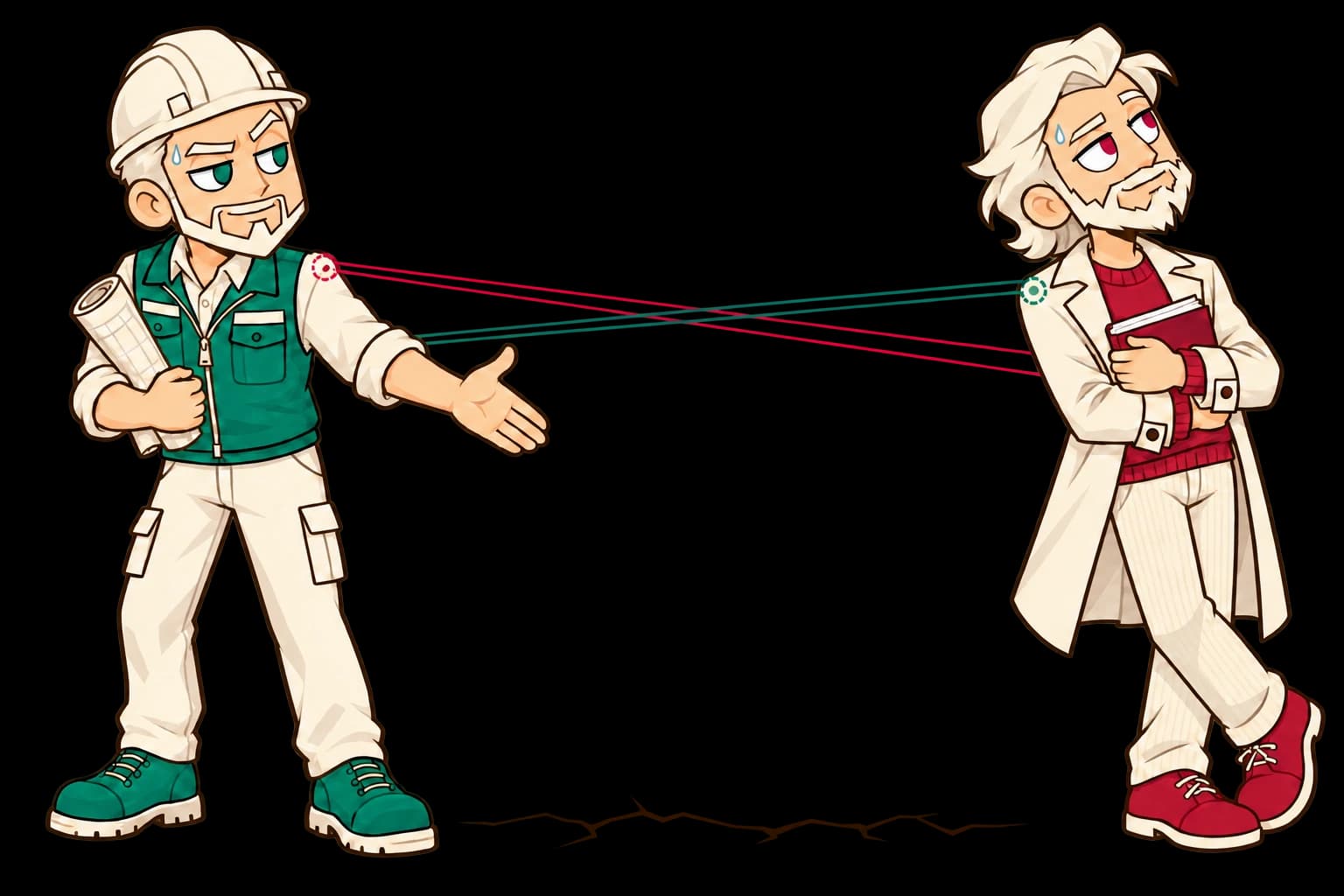
The strange thing about this relationship is that the pressure comes not from an action but from being understood. The supervisor understands the partner well—better than the supervisee expects. They can talk about what matters most to the supervisee in the same language, then correct them in that very area. When someone who speaks your language and knows the details of your field corrects you, it can be hard to answer. Think of an exam whose examiner does not know it is happening: one person sits anxiously writing, feeling every move is being watched, while the other walks around smiling, thinking they are being encouraging. This image will help explain what can seem puzzling about the relationship.
The nature of the relation
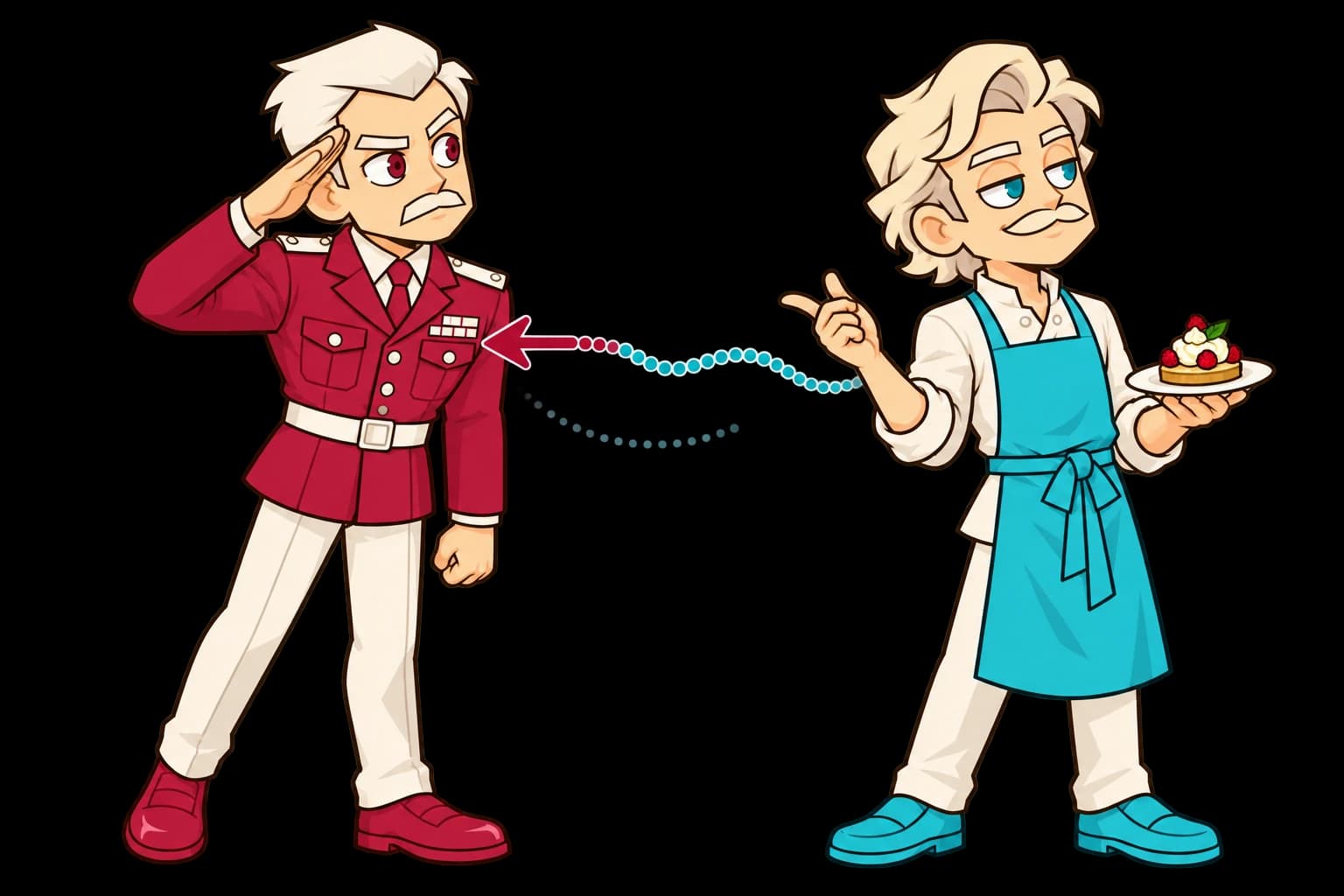
The relationship can be summed up in one sentence: the supervisor’s core lands on the supervisee’s weakest point, while the supervisee’s core is only a tool to the supervisor—a tool they understand and can correct. This idea draws on the eight aspects of personality described in “How to Read the Relationship Pages.” Every relationship is a particular way these aspects meet. In Supervision, one person’s strongest side stands over the other’s weakest, while the second person’s strongest side is merely a means in the first person’s hands.
The two direct channels in this relationship run from the supervisee to the supervisor, not the other way around. The supervisee’s tool reaches what the supervisor has to perform in public, and the supervisee’s quiet skill reaches the supervisor’s hidden need. This is why the supervisor finds the partner interesting and attractive and may feel genuinely drawn to them. The supervisor’s effect does not come through a channel; it comes through presence. Their core—a steady, unbroken current—lands directly on the supervisee’s vulnerable point, and their tool treats the supervisee’s most valued ability as something to be adjusted.
The heaviest exam is the one its examiner does not know they are giving.
A presence you feel but cannot see
What meets here: The supervisor’s core and the supervisee’s vulnerable point.
The result is pressure that needs no words. The supervisor’s presence alone—their way of approaching things, what they notice, and the standard they automatically apply—reminds the supervisee each time of a side they do not handle well. If asked to describe the feeling, the supervisee might say: “I get tense around them for no reason,” “I feel as if I’m being judged,” or “I seem less capable when they’re here.”
Here is the key to understanding the relationship: the supervisor does not feel this pressure and does not intend to cause it. They act naturally, as they do with everyone else, and do not realize that what comes easily to them lands on their partner’s most difficult point. They are surprised by the supervisee’s tension and may explain it as shyness or inexperience. Then they try even harder to encourage them—and that encouragement has a stronger effect because it comes from the very same source.
A correction in your own language
What meets here: The supervisee’s core and the supervisor’s tool.
The correction reaches deep. When the supervisor adjusts something the partner says in their own field—in the partner’s language and terms, with a detailed understanding of the subject—the supervisee has little to say in response. The words are accurate, and the speaker understands the topic. The correction even sounds like an improvement. But it lands on the side that defines the supervisee’s sense of self, making them feel that what sets them apart is not so special after all.
This is what separates Supervision from a relationship where both people correct each other. The supervisee cannot return the favor in the same way. Their strongest ability has become material in the partner’s hands, while the partner’s strongest ability lands on their sensitive point. The balance feels tilted because it is tilted.
What draws the supervisor to the supervisee
What meets here: The supervisee’s tool and the supervisor’s social role; the supervisee’s quiet skill and the supervisor’s hidden need.
The supervisor is genuinely drawn to the partner. They find them capable in an area that takes effort for them, and the partner’s spontaneous behavior gives them comfort and meets a need they do not know how to ask for. So they take an interest, bring the partner closer, speak well of them, and see potential they want to develop. This is the real motive behind the guidance that wears the supervisee down.
This explains the relationship’s central paradox: the person who creates the pressure is also the person who admires the partner and enjoys having them around. This is not hostility or rejection. From one side, it is sincere admiration accompanied by endless correction.
Where they do not meet
What meets here: The supervisor’s vulnerable point and the supervisee’s social role; what excites the supervisor and the supervisee’s hidden need; what the supervisor dismisses and what excites the supervisee.
Three more points complete the picture. First, the supervisor’s weakest side lands on a side that is already weak for the supervisee. The supervisee cannot hurt the supervisor even if they wanted to, so the supervisor remains completely safe. Second, the thing that excites the supervisor is exactly what the supervisee needs deep down. Both value that side but neither is good at it, so they talk about it often without either one providing it to the other. Third, what the supervisor dismisses is precisely what excites the supervisee, so the supervisee’s enthusiasm meets the supervisor’s indifference.
Together, these three points have one effect: the relationship gives in the direction of guidance and runs short in the direction of support. The supervisee receives plenty of correction but not what they need, and cannot unsettle the supervisor or stop the corrections. That is why withdrawal is the supervisee’s most common way out—not because they dislike the partner, whom they often respect, but because staying costs more than it gives.
What they share and where they differ
- ValuesThey belong to neighboring quadras and share half their values. Guidance usually focuses on this shared half, which is why the supervisor’s comments seem reasonable to the supervisee and are hard to answer. Their differences show up in larger priorities, where each may be surprised by what the other considers important.
- InterestsThey are in neighboring areas of interest, so they share a broad common ground that makes guidance possible and understandable. This cuts both ways: the overlap makes the supervisor’s observations precise and effective, and it also makes them hard to bear.
- Rhythm and energy directionThey differ in both. Different rhythms add clashes over plans and timing, which can become another subject for guidance: the supervisor corrects the partner’s rhythm as well as their method. Different energy directions add misunderstanding. If the supervisor is extraverted, they may seem more forceful than they are; if introverted, they may seem silent and watchful. Either way, the other person’s tension grows.
How it changes with closeness and time
No relationship stays at one distance or remains the same over time.
By distance
- From a distance
Things go well. The supervisor finds the partner pleasant and capable and praises them. The supervisee sees a respected person who knows what they are talking about, along with a slight discomfort they do not pay attention to. At this distance, the relationship is genuinely useful: a passing suggestion, an opinion on a problem, and mutual respect.
- At a moderate distance
Guidance begins. As they work together, the supervisor starts offering comments in good faith and with skill, while the supervisee starts to feel that everything they do is being reviewed. The first signs of withdrawal appear: the supervisee takes less initiative and prefers to work out of the supervisor’s sight.
- Up close
The cost is greatest for the supervisee. Living together means constant exposure to their weakest point and daily corrections to something they value. Still, closeness can work—in families and at work—if the supervisor understands the weight of their presence and stops correcting the field their partner values unless asked.
Over time
- The first meeting
The supervisor leaves with a positive impression; the supervisee leaves with a vague reservation. The supervisor is impressed by and interested in the partner. The supervisee feels respect mixed with discomfort but often explains it away as a passing personal impression.
- Getting closer
The pattern becomes clear. The supervisor starts offering guidance, and the supervisee starts constantly checking themselves in the supervisor’s presence. The supervisee may first try to prove their ability by showing what they do well, explaining it, and working hard. The partner then adjusts what they showed, using the same language. This moment can determine how the supervisee feels about the whole relationship.
- Settling into a pattern
The relationship settles into one of two forms. It may become an openly accepted supervisory relationship—a teacher and student, or a manager and employee who is still learning—with useful results and clear limits. Or it may claim to be equal while the supervisee builds up quiet resistance. This rarely becomes a direct confrontation; more often it appears as delay, disregard, and gradual distance.
- Over the long term
This relationship usually ends in one of two ways: the supervisee quietly withdraws, surprising the supervisor, who does not understand why; or the relationship becomes limited but respectful once the supervisor recognizes their effect and intervenes less. It is likely—though not the only possible explanation—that the outcome depends less on how much affection the two people feel and more on whether the supervisor understands that their presence alone can have an effect their words do not.
How each sees the other
The same relationship does not look the same from both sides. Here the difference between the two accounts is so large that the people may describe two completely different relationships: one describes a pleasant friendship with guidance, the other an endless exam.
From the supervisor’s side
The supervisor sees a capable, kind, interesting person. They find comfort in the partner’s behavior, benefit from their skills, and feel sincerely drawn to them. So they offer advice because they want the partner to make the most of their abilities and believe they can do even better.
Their particular risk is that they do not see the effect they have. They correct the very field through which the partner defines themselves, and their presence presses on the partner’s weakest point. Then they are surprised when the partner grows tense or withdraws, and may decide the person is too sensitive or lacks confidence. It is better to assume their words carry more weight than they think, avoid corrections in the field their partner values unless asked, and replace a correction with a question: “How do you see this?”
From the supervisee’s side
The supervisee sees a respected person who knows their field and whose opinion they genuinely value. That is part of the problem: if the other person’s comments were weak, they could dismiss them. But in their presence, the supervisee feels less capable than they are. What sets them apart seems to be treated as material for adjustment, and every attempt to prove themselves ends in another correction.
Their particular risk is to stay quiet and retreat until they lose confidence in their own field, or to suddenly explode after holding things in for too long over something minor. It is better to describe what is happening calmly and specifically: “I’d rather do this my way and show you the result.” They should also base their sense of their own ability on their work and its results, not on their partner’s opinion.
Putting both accounts together shows why the relationship can be repaired despite its imbalance: what happens is not hostility or superiority, but admiration from one side that comes across as pressure. A supervisor who understands this can make the relationship one of the most useful forms of guidance. A supervisee who understands it can stop reading the experience as a judgment of their worth.
The relation across areas of life
Friendship
Supervision friendships are possible and common, but they tend to be unequal: one friend gives guidance and the other receives it, even if neither agreed to those roles. At first, the supervisee may benefit because the guidance is real and the supervisor has real experience. It becomes tiring if the pattern does not change.
The best version is spaced out: a meeting now and then, a specific topic, and enough room between visits. Many such friendships fade quietly without a stated reason. The supervisee gradually meets less often; the supervisor is surprised by the distance and assumes the other person is busy. Knowing the pattern can save the friendship with a small change: offer less guidance and ask more questions.
Romance and marriage
The relationship often begins with attraction from the supervisor’s side. They find something comforting and appealing in the partner and see potential they want to bring out. The supervisee, in turn, finds someone impressive and worrying at the same time.
Living together puts the same issue to a daily test: constant presence presses on one person’s weakest points, while daily corrections touch what they value. Successful marriages do exist, and tend to rely on three things: clear areas where the supervisee has full control and is not reviewed; a firm habit on the supervisor’s part of asking instead of correcting; and time alone to reduce the effect of constant presence. The greatest danger is that the supervisee’s withdrawal is mistaken for a loss of affection. The supervisor then moves closer and tries harder, increasing the pressure they meant to ease.
Work and cooperation
At work, the relationship is useful when its direction matches the hierarchy: the supervisor is a trainer or manager during a defined period of learning. Then their behavior makes sense and feels acceptable, and the supervisee benefits from detailed feedback in their field. The same applies at home and at school, where the relationship can appear between a parent and child or teacher and student.
Things become difficult in two cases: supervision continues after the supervisee has matured and turns into overcontrol; or the roles are reversed and the supervisee becomes the supervisor’s manager. The supervisee then has authority but feels uneasy, while their employee corrects them without meaning to. In both cases, the practical solution is the same: put roles in writing, limit review to what the result requires, and openly acknowledge the supervisee’s competence in their field.
When they disagree
Every relationship has its own pattern of disagreement. In this one, conflict tends to pass through three stages.
- The spark
It usually starts on the supervisee’s side, over something small that does not seem to explain the strength of the reaction: one extra comment after many others, or a remark about work they consider their own field. A second spark comes from the other direction. The supervisor notices the partner’s coolness or withdrawal, reads it as ingratitude, and complains. A third spark is less visible but can have a greater effect: the supervisee takes an ordinary comment—something the supervisor said in passing and forgot a minute later—as a final judgment of their ability, and remembers it for weeks.
- Escalation
The disagreement follows a cycle that is difficult for both. The supervisee does not object at the time because they have no answer to a correction that is accurate. They keep it in and put off responding until it all builds up and they explode over something trivial. The supervisor is stunned: they never felt any pressure, meant no harm, and remember months of interest and useful feedback. They explain the outburst as oversensitivity and respond with even more guidance—the very remedy that makes things worse. The escalation runs in one direction: the supervisee has nothing that can hurt the supervisor, so they leave the disagreement more exhausted, while the supervisor leaves confused but not hurt.
- A way out
The best way out has two matching parts. The supervisee can describe what is happening without accusing the other person: “Your comments are precise and useful, but getting so many of them in this area is making me lose confidence in my work.” This moves the issue from a question of character to one of how the work is arranged. The supervisor can stop commenting entirely in one particular area rather than merely comment less. The supervisee notices a complete pause; they may not notice a reduction. When disagreements repeat, a little more distance helps. Here, distance is a remedy, not a punishment.
The relation in each pair
All sixteen pairs follow this general pattern, but what they exchange differs from pair to pair:
ILE’s stream of possibilities and open questions lands on LSI’s weakest point: every “What if?” shakes the system LSI worked hard to build. ILE then takes apart the logical structure and rearranges it flexibly, showing that another arrangement can be just as consistent. LSI has little to say in response. In return, ILE is drawn to the partner’s decisiveness, their ability to bring situations to a close, and their quiet care for comfort and daily needs.
LSI’s insistence on rules and consistency lands on SEE’s weakest point. The question “Why is this logically correct?” puts SEE in an area they do not handle well. LSI then meets SEE’s strong presence and direct pressure with equal pressure and does not back down. For the first time, SEE meets someone who stands up to them with their own kind of strength. In return, LSI is drawn to the partner’s confident judgments about people, their loyalty, and the warmth they bring to a room without even thinking about it.
SEE’s forceful presence and quick insistence on getting their way land on EII’s weakest point. A slight rise in SEE’s voice may be enough to make EII shrink back and lose their words. SEE then quickly and confidently reconsiders EII’s judgments about people and their loyalties: “They don’t deserve all that loyalty.” This hits deeply because SEE is speaking in the same area. In return, SEE is drawn to EII’s ability to see possibilities in people and their quiet sense of where things are headed.
EII’s calm judgments about people and their character land on ILE’s weakest point. A silent look or unspoken reservation can be enough to make ILE feel condemned. EII then takes ILE’s ideas and possibilities, adds to them, expands them, and connects them to people. ILE’s idea comes back looking better than it did at first. In return, EII is drawn to ILE’s consistent logic and quiet practical ability to get things done.
SEI’s attention to comfort, rhythm, and the body’s needs lands on EIE’s weakest point. Simply having a relaxed person beside them reminds EIE of how much they wear themselves out. SEI then gently lowers EIE’s visible warmth and intensity with humor, draining some of the force from the dramatic scene. In return, SEI is drawn to the partner’s confident talk about the future and their spontaneous openness to new possibilities.
EIE’s warmth and visible emotion land on ILI’s weakest point. Emotional noise drains ILI, who has little to offer in response. EIE then takes ILI’s sense of where things are headed and expresses it aloud with drama. ILI’s quiet insight becomes someone else’s speech. In return, EIE is drawn to the partner’s calculations of usefulness and efficiency and their quiet logical order.
ILI’s sense of where things are headed and doubts about the future land on LSE’s weakest point. The question “What about two years from now?” stops LSE’s momentum, and they have no answer ready. ILI then criticizes LSE’s efficiency and output by using the same standard: “This work costs more than it brings back.” LSE cannot easily respond because efficiency is their own standard. In return, ILI is drawn to the partner’s practical skill, care for quality, quiet decisiveness, and ability to move things forward.
LSE’s constant output and talk about work land on SEI’s weakest point. LSE’s presence alone feels like a steady demand for productivity SEI does not want. LSE then reorganizes SEI’s attention to comfort and a pleasant atmosphere and suggests ways to improve it. SEI’s own field has become a project for improvement. In return, LSE is drawn to the partner’s ability to soften the mood and their quiet, steady affection.
ESE’s open warmth and visible enthusiasm land on SLI’s weakest point. The unspoken demand to respond makes SLI feel cold and inadequate. ESE then reorganizes and adds to SLI’s skill and taste in the details of daily life, so SLI’s home and tools become subjects for suggestions. In return, ESE is drawn to the partner’s quiet practical competence and calm logical order.
SLI’s ease, contentment, and slower rhythm land on LIE’s weakest point. Seeing someone who is not rushing reminds LIE of a body they neglect and a life that is passing by. SLI then judges LIE’s efficiency and ambition by the standard of doing things well: “You spend more than you earn.” LIE has little room to escape the criticism because it comes from inside their own field. In return, SLI is drawn to the partner’s talk about where things are headed and their open possibilities that come without a cost.
LIE’s constant measuring of results and usefulness lands on IEI’s weakest point. The question “What have you accomplished?” touches IEI at their most exposed. LIE then turns IEI’s sense of time and what lies ahead into a plan with schedules and deadlines. IEI’s dreamlike vision becomes someone else’s project. In return, LIE is drawn to the partner’s ability to color a room’s atmosphere and move people, along with their quiet personal warmth.
IEI’s reflections on time and what lies ahead land on ESE’s weakest point. One word about something bad to come can spoil ESE’s whole day. IEI then creates the atmosphere—ESE’s most valued ability—with a small gesture instead of great effort, making ESE’s enthusiasm seem loud and excessive beside them. In return, IEI is drawn to the partner’s care for comfort and hospitality and their quiet presence that gets things moving.
LII’s insistence on consistency and precise definitions lands on IEE’s weakest point. The question “What exactly do you mean by that?” stops IEE and makes their enthusiasm seem baseless. LII then sorts through IEE’s possibilities and ideas and rejects most of them, leaving IEE’s best ideas as material to be refined. In return, LII is drawn to the partner’s quick judgments about people, their closeness to them, and their natural ability to make others feel welcome.
IEE’s openness to every possibility and every person lands on ESI’s weakest point. Endless flexibility threatens the boundaries ESI worked hard to build. IEE then rereads ESI’s judgments and loyalties more flexibly: “They’re not that bad; you just haven’t gotten to know them yet.” This hits deeply because IEE is speaking in ESI’s own field. In return, IEE is drawn to ESI’s decisiveness, ability to protect and say no, and quiet practical care for daily needs.
ESI’s silent judgments about character and loyalty land on SLE’s weakest point. Her disapproving silence reaches SLE in a way that direct confrontation does not. She then meets SLE’s strength and pressure with a steady, fearless firmness. For the first time, SLE meets someone who is not moved by their strength. In return, ESI is drawn to the clarity of SLE’s rules, their logical structure, and their quiet practical competence.
SLE’s strong presence and haste to settle things land on LII’s weakest point. Direct pressure freezes LII’s thinking and makes them back down before finishing their argument. SLE then takes LII’s logical structure, uses it in practice, and breaks away what does not help. LII’s precise system has become a tool in the hands of someone who does not treat it as sacred. In return, SLE is drawn to the partner’s ideas and possibilities and their quiet sense of where things are headed.
















What can change its course
The pattern above is how the relationship tends to work when other factors are equal. Four factors can shift it.
- SubtypeA dominant subtype in the supervisor’s position makes the relationship heavier because it gives more guidance and leaves less room. A harmonizing subtype in that position eases it considerably. In the supervisee’s position, a dominant subtype resists openly and returns comment for comment, turning the relationship into an early clash instead of quiet withdrawal. A harmonizing supervisee absorbs the pressure and makes themselves smaller. From outside, everything may look fine while the effect builds inside.
- Whether the core or the tool is strongerA supervisor with a stronger core creates heavier, more constant pressure because the core is an unbroken current. A supervisor with a stronger tool makes more corrections, but each is lighter. If the supervisee’s tool is stronger, they are more attractive to the supervisor and may be corrected more often. If their core is stronger, they hold more firmly to their own way and friction increases. The heaviest combination is when both have a stronger core.
- Maturity and experienceMore than anything else, this relationship depends on the supervisor’s awareness, because they are the one with more power to change it. A mature supervisor notices that the partner becomes tense in their presence and does not call it weakness; they make fewer comments and leave more room. An immature supervisor calls it inexperience and gives more guidance. The supervisee matures by seeing that the impact is a clash between their types, not a judgment of them. Experience also helps: someone with a record of good work can hear the same comment without being shaken by it.
- A third personA third person helps in two ways. They can witness the supervisee’s competence from outside the relationship and help restore their confidence. They can also pass along a comment that would carry less weight if it came directly from the supervisor. Since each type supervises one type and is supervised by another, a team connected by this relationship can form a chain without a clear head. Bringing in a type outside the chain can break it.
Strengths and friction
Strengths of the Supervision relationship
- Learning no other position offersThe supervisor sees what is going wrong for the partner with unusual precision, because they can look at the partner’s field from the inside with a flexible tool. The limit is that this learning can cost the supervisee confidence: they gain a skill but lose certainty.
- Accurate feedback at the heart of the matterThe supervisor’s comment reaches the core of the issue instead of its surface and can spare the supervisee years of trial and error. The limit is that the comment’s accuracy can make it impossible to answer, turning its usefulness into helplessness.
- Sincere admirationThe supervisor genuinely values the partner, speaks well of them when they are absent, and opens doors for them. The limit is that this admiration reaches the supervisee as guidance, not in a form they can enjoy. Open praise could change the whole relationship.
- Complete safety for the supervisorThe supervisee has nothing that can strike the supervisor’s weakest points, so the supervisor feels at ease and does not fear being hurt. The limit is that this safety blinds them: a person who is never hurt may not notice that they are hurting someone else.
- Strong results on well-defined tasksShared work can be precise and carefully reviewed because an expert eye has looked at it from within. The limit is that this quality is bought with pressure that does not show in the finished work. The cost looks like zero, but it is not.
Possible sources of friction
- Tension with no nameable causeThe supervisee feels less capable around the supervisor and cannot name why, so they blame themselves. This is less likely when they spend fewer hours together and handle some of the work in writing.
- A correction that is hard to answerThe supervisor adjusts the partner’s work in their own field and language, leaving the supervisee with no argument or way out. This is less likely if they agree on a specific area where the supervisor will not comment at all.
- Performing below one’s ability in front of a witnessThe supervisee makes mistakes at things they know how to do when the supervisor is there, so the supervisor forms a lower opinion of their ability than the facts support. This is less likely when the supervisee works alone and presents completed work instead of being watched while making it.
- Withdrawal mistaken for ingratitudeThe supervisee protects themselves by leaving, and may end the relationship all at once after a long period of patience. The supervisor reads this as ingratitude after everything they have done. This is less likely when the pattern is named for what it is: a clash between types, not hostility or a lack of gratitude.
- Encouragement that increases pressureThe supervisor notices the partner’s tension and doubles down on encouragement and guidance, so the same source that caused the tension now adds to it. This is less likely when they praise the result as it is before suggesting changes.
How to make it work
Good intentions alone are not enough. Small habits can address particular sources of friction.
- Set one area that is off limits for commentsThe most helpful habit is to agree on a field that belongs to the supervisee alone, where the supervisor does not comment at all rather than merely comment less. The supervisee may not notice fewer comments, but they notice when comments stop altogether.
- Praise the original work before suggesting a changeName what is good about the work as it stands before saying, “It would be better if you did this.” The supervisee does not need to hear what the best version would be; they need to know that what they made is good as it is.
- Reduce time spent togetherKeep face-to-face contact to what the work actually requires and do the rest separately. Here, pressure comes from presence more than from words. Distance is a remedy, not a punishment.
- Put comments in writingWrite the feedback and let the supervisee read it when they choose, instead of saying it while they work. Writing removes the speaker’s tone and presence, leaving only the useful content.
- Name the patternThe supervisee can describe how they feel without accusing the other person: “Getting so many comments in this area is making me lose confidence.” This is the only route that reaches the supervisor, because they do not see what they are doing and will not discover it on their own.
Telling it apart from similar relations
Three relationships can be confused with Supervision in everyday life. Each has a question that helps tell them apart.
Conflict
Like Supervision, one person’s strongest side lands on the other’s weakest point. The difference is that in Conflict this happens in both directions: each hurts the other without meaning to, both feel like the victim, and neither is at ease. In Supervision, the pressure runs one way, and one person may feel perfectly comfortable in a relationship the other finds difficult.
The key question: “Do you both feel tense around each other, or does one of you feel tense while the other thinks things are fine?”
Benefit
Like Supervision, the relationship is unequal: one person has more influence and the other learns more than they teach. But the influence feels different. In Benefit, one person’s words reach deeply, are accepted without resistance, and help without causing pain; that person’s complaint is that they are not heard. In Supervision, the words hit a painful point; the other person feels watched, judged, and tested.
The key question: “Do you feel you are learning from them but they do not listen to you, or do you feel watched and lose confidence in their presence?”
Reversed Supervision
The same relationship with the positions reversed: in another relationship with a different type, you stand where your partner stands here. That is why each of us can know both positions from experience and, if we choose, remember what the other side feels like.
The key question: “Which of you checks your words and feels judged, and which is surprised by the other’s tension and does not understand why?”
Conclusion
Accounts of this relationship agree that pressure runs in one direction. The supervisee describes familiar feelings—tension with no clear cause, a sense of being measured, and doing worse than they can—while the supervisor feels none of this and is surprised to hear about it. The relationship can be very useful for training over a limited period, but it can break down quickly when it continues without end. The way the types work together offers one explanation: the pressure with no obvious cause comes from the supervisor’s strongest side, an unbroken current they do not choose, landing on the partner’s weakest point. It comes from presence, not an action. The supervisee’s inability to respond comes from having their most valued ability turned into material for the other person’s flexible tool to reshape. The supervisor’s sincere admiration comes from the only two direct channels in this relationship running from the supervisee to the supervisor, not the other way around. It remains possible—though this would need to be checked in real work teams—that distance, writing, and setting an area where comments are not allowed can break down much of the pressure people associate with this relationship.
What may have seemed like separate details comes back to one pattern: one person’s strongest side stands over the other’s weakest, constantly and without intention, while the second person’s strongest side becomes material in the first person’s hands. This one pattern creates tension with no clear cause, corrections that cannot be answered, sincere admiration, and withdrawal that is not understood.
This explains the contradictions that puzzle people in this relationship: its strongest pressure is not said but felt in someone’s presence; its most sincere affection arrives in a form that tires the person receiving it; and the person who feels most at ease may be the one causing the other’s exhaustion. A teacher who does not know they are giving an exam, and a student who does not know they are loved.
From the outside, the relationship may look like one person is oversensitive and the other controlling. From the inside, it is like reading under a bright light shining from over your shoulder. The light is useful in itself, and the person holding it thinks they are helping but cannot see the reader’s face. Yet the reader cannot look away from the page without everything in front of them flaring up.
What your relationship needs is not for either person to change; what is happening is not a flaw in either of you. You need to understand the direction of the pattern and respond in a way that fits: an area where no comments are made, praise before suggestions, and distance without blame. The light does not need to be switched off. Its holder only needs to take one step to the side for the page to become readable again.
This description applies to every pair in a Supervision relation.Browse the fourteen relation types